Tropical shrimp farming and its sustainability
Share
抄録
In December 1996, the Supreme Court of India ordered the closure of all semi-intensive and intensive shrimp farms within 500 m of the high tide line, banned shrimp farms from all public lands, and required farms that closed down to compensate their workers with 6 years of wages in a move to protect the environment and prevent the dislocation of local people. If the 1988 collapse of farms across Taiwan provided evidence of the environmental unsustainability of modern shrimp aquaculture, the landmark decision of India's highest court focused attention on its socioeconomic costs.
This chapter briefly describes shrimp farming, discusses its ecological and socioeconomic impacts and recommends measures to achieve long-term sustainability including improved farm management, integrated coastal zone management, mangrove conservation and rehabiUtation, and regulatory mechanisms and policy instruments.
Suggested Citation
Primavera, J. H. (1998). Tropical shrimp farming and its sustainability. In S. S. De Silva (Ed.), Tropical Mariculture (pp. 257–289). San Diego, California: Academic Press.
主題

Taxonomic term

Collections
Related items
Showing items related by title, author, creator and subject.
-
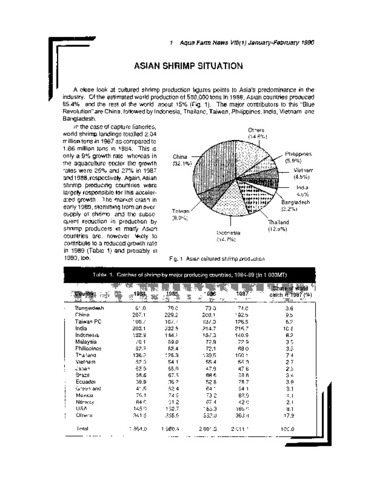
Asian shrimp situation
(Aquaculture Department, Southeast Asian Fisheries Development Center, 1990) -
Cooperative Research Networking to Facilitate Research and Development for the Reduction of Wastage in Shrimp Fisheries
(Training Department, Southeast Asian Fisheries Development Center, 1997)Because of the importance of shrimp trawling fisheries in a number of countries in Asia and the Indian Ocean region and recommendations for more research work in the field of selectivity, in particular through more cooperation ... -
Seagrass Bed Restoration by Fishermen at Hinase in Japan
(Training Department, Southeast Asian Fisheries Development Center, 2016)Habitat rehabilitation which is very important for fishery resources enhancement should be conducted following the community-based management and ecosystem-based management. In Japan, the Satoumi concept is introduced as ...