Aquaculture
Share
นามธรรม
Biophysical impacts of aquaculture, with consequences for biodiversity, vary with species and culture systems and include issues such as: nutrient enrichment/removal, chemicals, land use, species introductions, genetic flow to wild populations, disturbance of balance or introduction of pathogen/parasites, consumption of capture fishery resources, energy, and greenhouse gas emissions. Guiding principles, labeling schemes and various tools are needed to analyze performance and conformance. Ecological footprints and life-cycle analysis aim to capture biophysical performance, including up- and downstream effects of policy decisions. Aquaculture provides a range of services but also makes demands and impacts on ecosystem functions, services, and thus biodiversity.
Description
This article is a revision of the previous edition article by Kautsky, N., Folke, C., Rönnbäck, P., Troell, M., Beveridge, M., Primavera, J., Volume 1, pp. 185-198, © 2001, Elsevier Inc.
การอ้างอิง
Troell, M., Kautsky, N., Beveridge, M., Henriksson, P., Primavera, J., Rönnbäck, P., & Folke, C. (2013). Aquaculture. In S. A. Levin (Ed.), Encyclopedia of Biodiversity (2nd ed., Vol. 1, pp. 189-201). Waltham: Academic Press.
เรื่อง

คอลเลกชัน
รายการที่เกี่ยวข้อง
แสดงรายการที่เกี่ยวข้องตามชื่อผู้แต่งผู้สร้างและเรื่อง
-
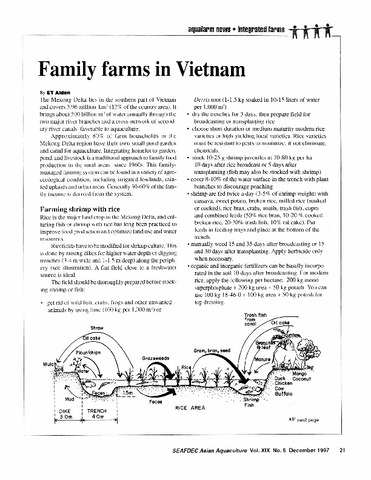
Family farms in Vietnam
(Aquaculture Department, Southeast Asian Fisheries Development Center, 1997) -
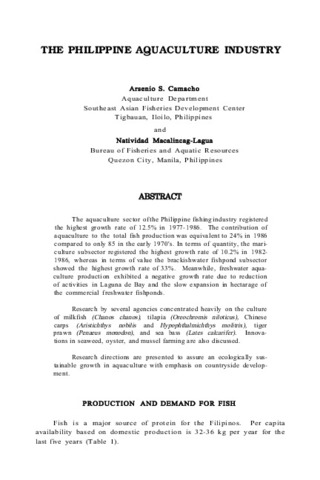
The Philippine aquaculture industry
(Aquaculture Department, Southeast Asian Fisheries Development Center, 1988)The aquaculture sector of the Philippine fishing industry registered the highest growth rate of 12.5% in 1977-1986. The contribution of aquaculture to the total fish production was equivalent to 24% in 1986 compared to ... -
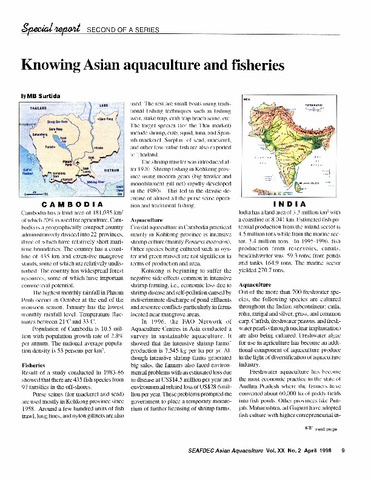
Knowing Asian aquaculture and fisheries
(Aquaculture Department, Southeast Asian Fisheries Development Center, 1998-04)This article is the second of four parts.