Limnological notes on the finfish production problem of Laguna de Bay.
Share
abstrak
Environmental problems have significantly affected fishery production and management in Laguna de Bay, the largest lake in the Philippines. Fishermen and fishpen operators are complaining about the slow growth of fish and low yields in the lake. In the 70’s two croppings were possible in fishpens since it took only 3 to 4 months then rear milkfish from fingerlings to marketable size (Felix, 1976). But in the early 80’s, stocked fingerlings attained a marketable size of about 200 g after 8 to 15 months (LLDA, 1983). In 1973 when the total fishpen area was only 5,000 ha, the annual harvest was 4 metric tons (MT)/ha. When fishpens covered 31,000 ha of the lake area in 1982, the annual yield dropped to 2 MT/ha (Centeno et al., 1987). Furthermore, the total open water catch of nearly 83,000 MT in the early 60’s (Rabanal et al., 1964) was reduced to one-fourth in the 80's.
While the big drop in yield has been largely attributed to the proliferation and mismanagement of fishpens, over-exploitation of lake resources, and seasonal changes in the productivity of the lake (Centeno et al., 1987), the author attributes the present crisis basically to a lack of understanding o the basic ecological attributes of Laguna de Bay and their relation to fish growth and production. This paper is a brief commentary on the Limnological characteristics of Laguna de Bay tat are quite important in finfish production.
Suggested Citation
Santiago, A. E. (1988). Limnological notes on the finfish production problem of Laguna de Bay. Natural and Applied Science Bulletin , 40(2), 119-121. http://hdl.handle.net/10862/1291
Subjek
Taxonomic term
Koleksi
- AQD Journal Articles [1249]
Related items
Showing items related by title, author, creator and subject.
-
Small-scale freshwater aquaculture development: Experiences from the Philippines on giant freshwater prawn, milkfish and tilapia
(Japan International Cooperation Agency, 2013-12)The Aquaculture Department of the Southeast Asian Fisheries Development Center (SEAFDEC/AQD) has been promoting a number of programs towards effective dissemination and adoption of science-based aquaculture technologies ... -
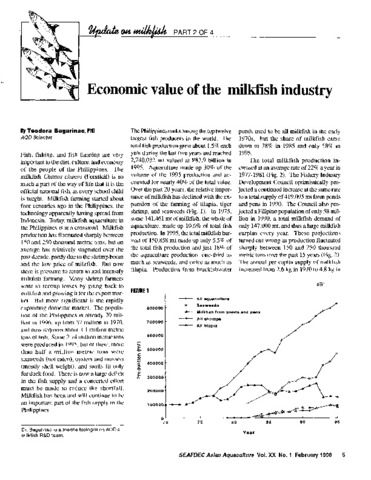
Economic value of the milkfish industry
(Aquaculture Department, Southeast Asian Fisheries Development Center, 1998)A brief description is given of the milkfish (Chanos chanos) farming industry in the Philippines. Over the past 20 years, the relative importance of milkfish has declined with the expansion of tilapia, tiger shrimp and ... -
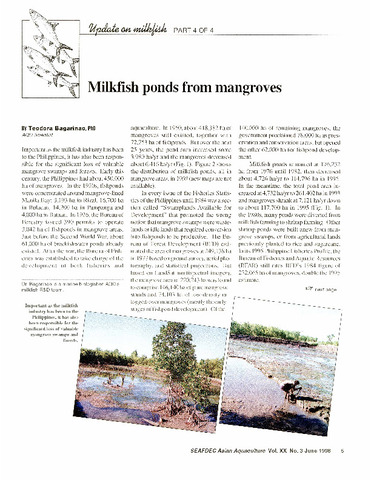
Milkfish ponds from mangroves
(Aquaculture Department, Southeast Asian Fisheries Development Center, 1998)