Density dependent growth of the tropical abalone Haliotis asinina in cage culture

Share
Abstract
The effects of different stocking densities on the growth, feed conversion ratio and survival of two size groups of the tropical abalone Haliotis asinina were determined. Three culture trials were conducted in net cages installed in a sheltered cove, Guimaras Province, Philippines. Trials 1 and 2 were conducted using 15–20 mm abalone juveniles for 150 days, while trial 3 was conducted using 35–40 mm abalone for 180 days. The animals were fed sufficient amounts of the red alga, Gracilariopsis bailinae (=G. heteroclada), throughout the experiment. There was an inverse relationship between growth (length and weight) and stocking density. Feed conversion ratio was not influenced by density, but was observed to be higher for larger animals. Survival was not significantly affected by density. Net cages are appropriate for culture of H. asinina. This study showed that H. asinina can reach commercial size of about 60 mm in one year. It also showed that growth of H. asinina can be sustained on a single-species diet. An economic analysis will be important in choosing the best stocking density for commercial production.
Suggested Citation
Capinpin, E. C., Jr., Toledo, J. D., Encena II, V. C., & Doi, M. (1999). Density dependent growth of the tropical abalone Haliotis asinina in cage culture. Aquaculture , 171(3-4), 227-235. https://doi.org/10.1016/S0044-8486(98)00490-6
Subject
Koleksi
- AQD Journal Articles [1249]
Related items
Showing items related by title, author, creator and subject.
-
The effect of stocking density, temperature and light on the early larval survival of the abalone Haliotis asinina Linné
(Phuket Marine Biological Center, 2001)Newly hatched trocophore larvae of the abalone haliotis asinina linne were stocked at densities of 1000, 3000 and 5000 larvae/1 at low (20-25oC) and high (ambien, 28-30oC) water temperature levels in ... -
Grow abalone in ponds
(Aquaculture Department, Southeast Asian Fisheries Development Center, 1997) -
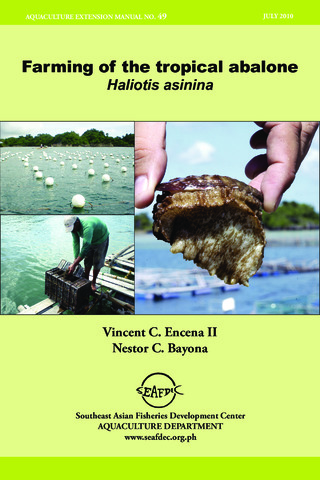
Farming of the tropical abalone Haliotis asinina
(Aquaculture Department, Southeast Asian Fisheries Development Center, 2010)This manual was written to provide abalone growers a practical guide on how to culture abalone based on the studies and trials conducted by SEAFDEC Aquaculture Department.