Threonine requirement of juvenile marine shrimp Penaeus monodon
Quan điểm/
Ngày
1997Page views
968metadata
Hiển thị bản ghi đầy đủ mặt hàngCited times in Scopus
Share
trừu tượng
The threonine requirement was determined for juvenile marine shrimp. Penaeus monodon postlarvae, PL20, were stocked in 30-1 fiberglass tanks at ten shrimp per tank arranged in a completely randomized design with six replicates per treatment. They were fed amino acid test diets (40% protein) with casein-gelatin as natural protein sources and supplemented with crystalline L-amino acids to simulate the amino acid profile of shrimp muscle except for threonine. Graded levels of threonine were incorporated to obtain 0.72, 1.0, 1.28, 1.56, 1.84, and 2.12 g per 100 g diet or 1.8, 2.5, 3.2, 3.9, 4.6, and 5.3% of dietary protein. Relationship of weight gain with dietary threonine level was analyzed by the quadratic regression method to derive the threonine requirement. Results showed that the quantitative threonine requirement for growth is 1.4% of the diet or 3.5% of dietary protein. This requirement for growth conforms with the threonine level in the shrimp muscle.
Suggested Citation
Millamena, O. M., Bautista, M. N., Reyes, O. S., & Kanazawa, A. (1997). Threonine requirement of juvenile marine shrimp Penaeus monodon. Aquaculture , 151(1-4), 9-14. https://doi.org/10.1016/S0044-8486(96)01486-X
Taxonomic term
Bộ sưu tập
- AQD Journal Articles [1249]
Related items
Showing items related by title, author, creator and subject.
-
An overview of the nutrition, feed and feeding techniques of prawn penaeid/shrimps
(Philippine Council for Aquatic and Marine Research and Development, 1989)This paper echoes what transpired during the first International Conference of Penaeid Prawns/Shrimps held in Iloilo City in December 4-7, 1984, particularly on the Nutrition nd Feed Development. Around 25 papers were ... -
Prawn hatchery operations
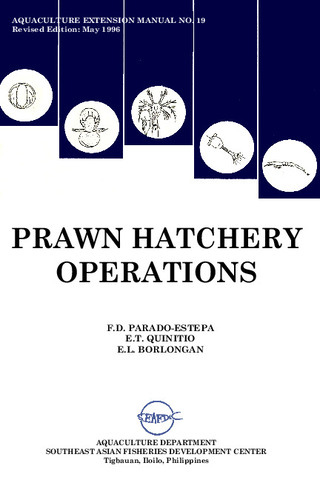
(Aquaculture Department, Southeast Asian Fisheries Development Center, 1996-05)The manual, an updated version of the 1984 SEAFDEC/AQD manual, presents the underlying principles and step-by-step instructions of prawn larval and post-larval rearing. The techniques described are not only applicable to ... -
The lowdown on world shrimp culture - II
(INFOFISH, 2001)This paper introduces some new members of the international shrimp culture club and goes on to discuss some recent technological innovations in the industry, particularly the polyculture of tilapia (mainly Oreochromis ...