Effect of salinity, dietary lipid source and level on growth of milkfish (Chanos chanos) fry
Share
စိတ္တဇ
Six semi-purified microparticulate diets containing coconut oil (CO), cod liver oil (CLO), and their 1:1 combination (CO+CLO) at 9% and 18% levels were fed to milkfish fry or late postlarvae in freshwater (0 ‰), brackishwater (16‰), and seawater (34‰) for 30 days. A three-factor factorial design (3×2×3) with three replicates per treatment was followed. Sixty-five milkfish fry (5 mg, 6 mm) were stocked per 15-l rectangular glass aquarium and fed with the experimental diets at 20% of biomass daily. Water temperature was 28±1°C during the culture period. Survival was not affected by water salinity, and lipid source or level. Among the 18 treatments, freshwater-reared milkfish fry fed with 9% CO+CLO had the highest specific growth rate, but this was not significantly different from those of freshwater-reared fish fed with 9–18% CO and 9% CLO diets or brackishwater-reared fish fed with 9% CO diet (P>0.05). As a main factor, salinity or dietary lipid level, but not lipid source, had significant effects on growth and feed conversion ratio of milkfish fry. Highest growth was observed in fish reared in freshwater and as salinity was increased, growth decreased (P<0.05). Overall, the 9% lipid diets promoted better growth than the 18% lipid diets (P<0.05). Except for the significant interaction between dietary lipid source and level indicating that milkfish fry fed with the 18% CLO was the shortest (P<0.05), no other significant effects of the two- or three-factor interactions were found.
Suggested Citation
Alava, V. R. (1998). Effect of salinity, dietary lipid source and level on growth of milkfish (Chanos chanos) fry. Aquaculture , 167(3-4), 229-236. https://doi.org/10.1016/S0044-8486(98)00317-2
ဘာသာရပ်
Taxonomic term
စုစည်းမှုများ စုစည်းမှုများ
- AQD Journal Articles [1249]
Related items
Showing items related by title, author, creator and subject.
-
Small-scale freshwater aquaculture development: Experiences from the Philippines on giant freshwater prawn, milkfish and tilapia
(Japan International Cooperation Agency, 2013-12)The Aquaculture Department of the Southeast Asian Fisheries Development Center (SEAFDEC/AQD) has been promoting a number of programs towards effective dissemination and adoption of science-based aquaculture technologies ... -
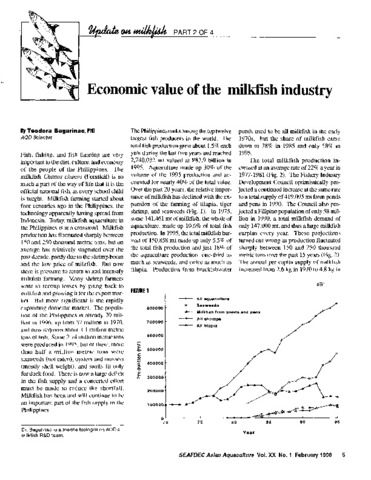
Economic value of the milkfish industry
(Aquaculture Department, Southeast Asian Fisheries Development Center, 1998)A brief description is given of the milkfish (Chanos chanos) farming industry in the Philippines. Over the past 20 years, the relative importance of milkfish has declined with the expansion of tilapia, tiger shrimp and ... -
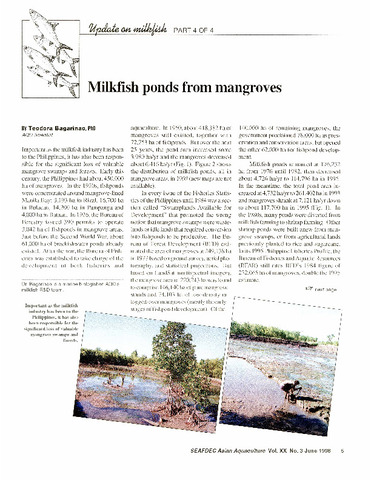
Milkfish ponds from mangroves
(Aquaculture Department, Southeast Asian Fisheries Development Center, 1998)