Culture and economics of wild grouper (Epinephelus coioides) using three feed types in ponds
Share
စိတ္တဇ
The performance of wild Epinephelus coioides juveniles was compared by feeding with live tilapia juveniles, fish by-catch, and formulated diet for 5 months in grow-out ponds. To minimize cannibalism, the groupers were graded into small (BW=24.9±7.3 g), medium (45.8±5.7 g), and large (84.1±30.0 g) size groups as block in a Randomized Complete Block Design (RCBD) and reared in nine 350-m2 ponds. To supply the tilapia juveniles, adult tilapia were grown 2 months prior to stocking of grouper at a rate of 15 tilapia/grouper. Grouper fed by-catch were significantly higher (P<0.01) than the other treatments in terms of final length and total production. The quality of by-catch could be gleaned by its efficient feed conversion ratio (FCR) of 1.0 (dry basis), significantly better (P<0.01) than the formulated diet that had an FCR of 2.8. Using by-catch, 47% of the harvest weighed >400 g and only 14% was classified <200 g. The cost of juvenile grouper and feeds represented 88–89% of the total investment in all treatments. Economic sensitivity analysis showed that a combination of improvement in factors such as price of grouper juveniles, feeds, yield, survival, and FCR would result in higher return-on-investment (ROI). When cost and returns were considered, feeding juveniles with by-catch was more profitable because it resulted in net income of Php 361,623/ha/year, an ROI of 155%, and a payback period of 0.4 year. The results clearly show that these economic indicators appear to be attractive, thus making grouper pond culture using by-catch a viable industry. More research efforts should, however, be directed towards developing a cost-effective formulated diet for the grow-out culture of E. coioides.
Suggested Citation
Bombeo-Tuburan, I., Coniza, E. B., Rodriguez, E. M., & Agbayani, R. F. (2001). Culture and economics of wild grouper (Epinephelus coioides) using three feed types in ponds. Aquaculture , 201(3-4), 229-240. https://doi.org/10.1016/S0044-8486(01)00744-X
ဘာသာရပ်
စုစည်းမှုများ စုစည်းမှုများ
- AQD Journal Articles [1249]
Related items
Showing items related by title, author, creator and subject.
-
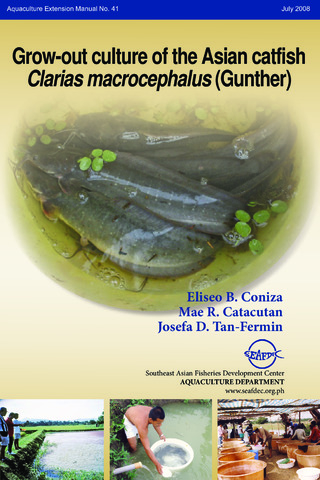
Grow-out culture of the Asian catfish Clarias macrocephalus (Gunther)
(Aquaculture Department, Southeast Asian Fisheries Development Center, 2008)Asian catfish Clarias macrocephalus is an esteemed food fish especially in Southeast Asia due to its tender and delicious meat. This commodity constitutes a valuable fishery for small-scale fishers in the region and has a ... -
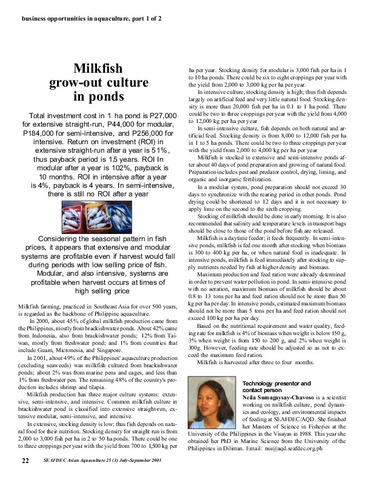
Milkfish grow-out culture in ponds
(Aquaculture Department, Southeast Asian Fisheries Development Center, 2003)Milkfish farming is regarded as the backbone of Philippine aquaculture. In 2001, nearly 50% of the Philippines' aquaculture production was milkfish cultured from brackishwater ponds. It has 3 major culture systems: extensive; ... -
Recent developments in aquaculture in Japan
(Aquaculture Department, Southeast Asian Fisheries Development Center, 1995)Aquaculture production in Japan in 1993 was 1,351,000 tons, 15.6% of the total fisheries production. About 93.6% came from mariculture and 6.4% from freshwater aquaculture. The per cent contribution of aquaculture to total ...