Prevalence of white spot syndrome virus (WSSV) in wild shrimp Penaeus monodon in the Philippines
URL ที่เชื่อมโยง
www.int-res.comวันที่
2007Page views
1,074เมตาดาต้า
แสดงระเบียนรายการเต็มCited times in Scopus
Share
นามธรรม
Prevalence of white spot syndrome virus (WSSV) was determined using polymerase chain reaction (PCR) methodology on DNA extracted from the gills of wild black tiger shrimp Penaeus monodon collected from 7 sampling sites in the Philippines. These 7 sampling sites are the primary sources of spawners and broodstock for hatchery use. During the dry season, WSSV was detected in shrimp from all sites except Bohol, but during the wet season it was not detected in any site except Palawan. None of the WSSV-PCR positive shrimp showed signs of white spots in the cuticle. Prevalence of WSSV showed seasonal variations, i.e. prevalence in dry season (April to May) was higher than in the wet season (August to October). These results suggest that WSSV has already become established in the local marine environment and in wild populations of P. monodon. Thus, broodstock collected during the dry season could serve as the main source of WSSV contamination in shrimp farms due to vertical transmission of the virus in hatcheries.
การอ้างอิง
de la Peña, L. D., Lavilla-Pitogo, C. R., Villar, C. B. R., Paner, M. G., Sombito, C. D., & Capulos, G. C. (2007). Prevalence of white spot syndrome virus (WSSV) in wild shrimp Penaeus monodon in the Philippines. Diseases of Aquatic Organisms , 77(3), 175-179. https://doi.org/10.3354/dao01834
DOI
10.3354/dao01834เรื่อง
Taxonomic term
คอลเลกชัน
- AQD Journal Articles [1249]
รายการที่เกี่ยวข้อง
แสดงรายการที่เกี่ยวข้องตามชื่อผู้แต่งผู้สร้างและเรื่อง
-
An overview of the nutrition, feed and feeding techniques of prawn penaeid/shrimps
(Philippine Council for Aquatic and Marine Research and Development, 1989)This paper echoes what transpired during the first International Conference of Penaeid Prawns/Shrimps held in Iloilo City in December 4-7, 1984, particularly on the Nutrition nd Feed Development. Around 25 papers were ... -
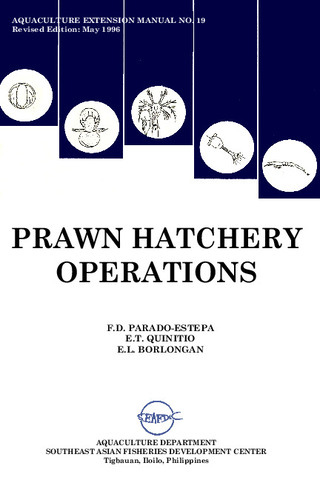
Prawn hatchery operations
(Aquaculture Department, Southeast Asian Fisheries Development Center, 1996-05)The manual, an updated version of the 1984 SEAFDEC/AQD manual, presents the underlying principles and step-by-step instructions of prawn larval and post-larval rearing. The techniques described are not only applicable to ... -
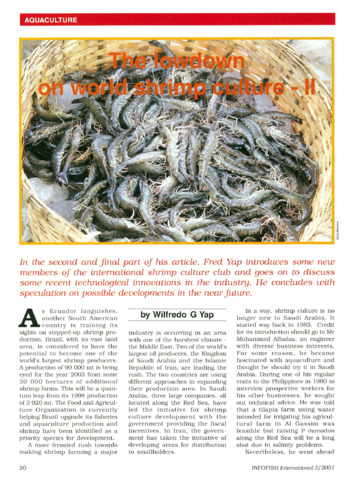
The lowdown on world shrimp culture - II
(INFOFISH, 2001)This paper introduces some new members of the international shrimp culture club and goes on to discuss some recent technological innovations in the industry, particularly the polyculture of tilapia (mainly Oreochromis ...