Evaluation of density and cage design for the nursery and grow-out of the tropical abalone Haliotis asinina Linne 1758
រកមើល / បើក
កាលបរិច្ឆេទ
2013Page views
916ទិន្នន័យមេតា
មើលកំណត់ត្រាលម្អិតនៃធាតុCited times in Scopus
Share
អរូបី
The effect of stocking density and cage design on the growth, survival rate, and feed conversion ratio was evaluated for the nursery (11–15 mm in shell length) and juvenile grow-out (26–30 mm in shell length) of the tropical abalone Haliotis asinina. Abalone were fed Gracilaria sp. within a randomized 2 × 3 factorial experiment using 2 stocking densities (Tl (500 pieces/m2) and T2 (1,000 pieces/m2)) and 3 cages (D1, box; D2, mesh cage; D3, prefabricated multitier trays). In addition, 3 stocking densities (T1, 50 pieces/m ; T2, 100 pieces/m; T3, 200 pieces/m) were evaluated in the prefabricated multitier trays. We found that, in the nursery experiment, 4-mo-old tropical abalone juveniles reared for 90 d showed no significant differences in growth (shell length and body weight) and survival rates among the 3 nursery cages used (Tukey's post hoc test, P > 0.05). Feed conversion ratio, however, was lowest for the high-density treatment T1D3 (7.8 ± 0.76) and was significantly different from the low density treatment T1D1 (11.32 ± 1.2) and intermediate density treatment T1D2 (12.39 ± 1.12; t-test, P > 0.05). Conversely, at higher densities (T2), the same trend applied with abalone reared in multitier basket systems (T2D3), having the highest growth rates and survival rates (29.3 ± 0.07 mm average shell length (ASL) and 5.16 ± 0.52 g average body weight (ABW)), followed closely by those reared in mesh cages (T2D2) and boxes (T2D1). Feed conversion ratio was also lowest for T2D3 (7.56 ± 0.79) and was significantly lower than T2D1 and T2D2. Between treatments, however, abalone reared at lower densities (T1) had significantly higher growth and survival than those reared at higher densities (T2), regardless of the nursery cage used, indicating an inverse relationship between stocking density, growth, and survival. For the grow-out study, tropical abalone reared in multitier trays at low densities (T1) attained the highest growth in shell length and body weight (49.7 ± 0.11 mm ASL and 29.8 ± 2.6 g ABW, respectively) at 180 d of culture, which was significantly greater than those reared in the high-density treatment (T3) with significantly smaller shell length and body weight (43.8 ± 0.18 mm ASL and 21.2 ± 2.0 g ABW), but not significantly different than the intermediate density treatment. This trend started from day 60 of culture onward when analyzed using Duncan's multiple range test (P > 0.05). Survival rates were not significantly different among stocking density treatments, nor were feed conversion ratios. We recommend, for nursery rearing of abalone juveniles, using multitier trays (D3) or boxes (D1) at 500 pieces/m2 stocking density to attain a grow-out size of 26–30 mm in shell length in 90 days. A stocking density of 100 pieces/m2 is recommended to grow abalone in multitier trays to attain a cocktail size of 50 mm ASL and 30 g ABW in 180 d with survival rates between 85.6% and 83.1%.
Suggested Citation
Encena II, V. C., de la Peña, M., & Balinas, V. T. (2013). Evaluation of density and cage design for the nursery and grow-out of the tropical abalone Haliotis asinina Linne 1758. Journal of Shellfish Research , 32(1), 21-27. https://doi.org/10.2983/035.032.0105
ប្រធានបទ
បណ្តុំបណ្តុំ
- AQD Journal Articles [1249]
Related items
Showing items related by title, author, creator and subject.
-
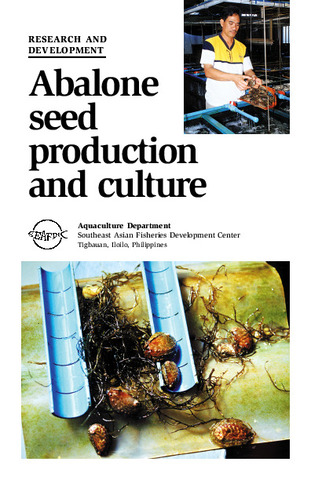
Abalone seed production and culture
(Aquaculture Department, Southeast Asian Fisheries Development Center, 2000)Details the research conducted at AQD for the tropical abalone Haliotis asinina. AQD has developed the rudiments of a hatchery protocol. -
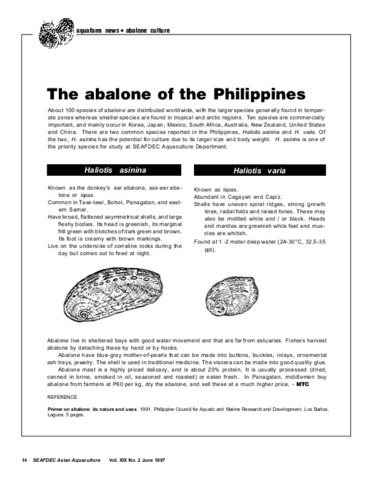
The abalone of the Philippines
(Aquaculture Department, Southeast Asian Fisheries Development Center, 1997) -
Community-based Stock Enhancement of Abalone, Haliotis asinina in Sagay Marine Reserve: Achievements, Limitations and Directions
(Training Department, Southeast Asian Fisheries Development Center, 2016)The Sagay Marine Reserve (SMR) under the National Integrated Protected Area System (NIPAS) is one of the many reef areas in the Visayan Sea in the central part of the Philippine archipelago. The SMR covers 32,000 ha or 59% ...