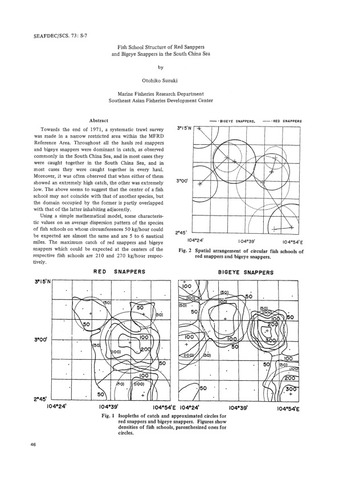
Fish school structure of red snappers and bigeye snappers in the South China Sea
Share
Abstract
Towards the end of 1971, a systematic trawl survey was made in a narrow restricted area within the MFRD Reference Area. Throughout all the hauls red snappers and bigeye snappers were dominant in catch, as observed commonly in the South China Sea, and in most cases they were caught together in the South China Sea, and in most cases they were caught together in every haul. Moreover, it was often observed that when either of them showed an extremely high catch, the other was extremely low. The above seems to suggest that the center of a fish school may not coincide with that of another species, but the domain occupied by the former is partly overlapped with that of the latter inhabiting adjacently.Using a simple mathematical model, some characteristic values on an average dispersion pattern of the species of fish schools on whose circumferences 50 kg/hour could be expected are almost the same and are 5 to 6 nautical miles. The maximum catch of red snappers and bigeye snappers which could be expected at the centers of the respective fish schools are 210 and 270 kg/hour respectively.
Suggested Citation
Suzuki, O. (1977). Fish school structure of red snappers and bigeye snappers in the South China Sea. In Proceedings of the Technical Seminar on South China Sea Fisheries Resources, Bangkok, Thailand, 21-25 May 1973 (pp. 46-49). Tokyo, Japan: Japan International Cooperation Agency.
Paksa

Related items
Showing items related by title, author, creator and subject.
-
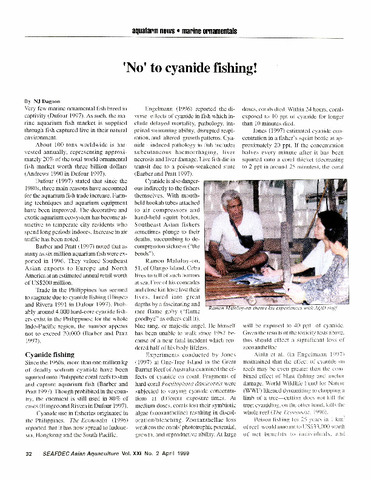
'No' to cyanide fishing!
(Aquaculture Department, Southeast Asian Fisheries Development Center, 1999) -
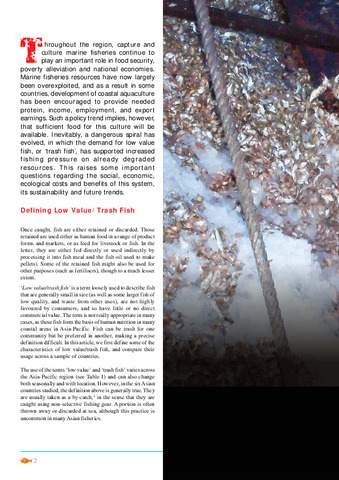
Prized commodity: Low value/trash fish from marine fisheries in the Asia-pacific region
(Secretariat, Southeast Asian Fisheries Development Center, 2005)The use of the terms 'low value' and 'trash fish' varies across the Asia-Pacific region and can also change both seasonally and with location. This article defines low value/trash fish as 'Fish that have a low commercial ... -
CRM in the Philippines: Lessons learned
(Aquaculture Department, Southeast Asian Fisheries Development Center, 1996)Philippine coastal communities can become capable fishery resource managers and that their management practices can become largely self-sustaining if the project approach focuses on assisting fishermen to learn how to help ...