Harnessing the benefits of breeding the Asian medicinal leech
Share
trừu tượng
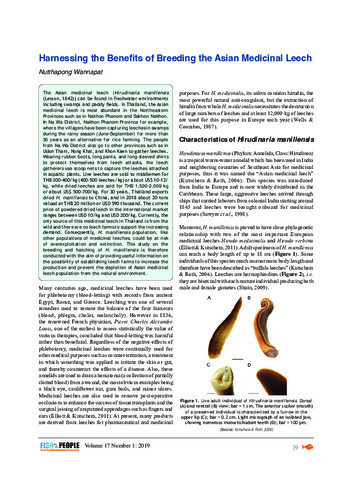
The Asian medicinal leech (Hirudinaria manillensis (Lesson, 1842)) can be found in freshwater environments including swamps and paddy fields. In Thailand, the Asian medicinal leech is most abundant in the Northeastern Provinces such as in Nakhon Phanom and Sakhon Nakhon. In Na Wa District, Nakhon Phanom Province for example, where the villagers have been capturing leeches in swamps during the rainy season (June-September) for more than 30 years as an alternative for rice farming. The people from Na Wa District also go to other provinces such as in Udon Thani, Nong Khai, and Khon Kaen to gather leeches. Wearing rubber boots, long pants, and long-sleeved shirts to protect themselves from leech attacks, the leech gatherers use scoop nets to capture the leeches attached in aquatic plants. Live leeches are sold to middlemen for THB 300-400/kg (400-500 leeches/kg) or about US$ 10-12/kg, while dried leeches are sold for THB 1,500-2,000/kg or about US$ 500-700/kg. For 30 years, Thailand exports dried H. manillensis to China, and in 2018 about 20 tons valued at THB 20 million or USD 590 thousand. The current price of powdered dried leech in the international market ranges between USD 10/kg and USD 200/kg. Currently, the only source of this medicinal leech in Thailand is from the wild and there are no leech farms to support the increasing demand. Consequently, H. manillensis population, like other populations of medicinal leeches, could be at risk of overexploitation and extinction. This study on the breeding and hatching of H. manillensis is therefore conducted with the aim of providing useful information on the possibility of establishing leech farms to increase the production and prevent the depletion of Asian medicinal leech population from the natural environment.
Suggested Citation
Wannapat, N. (2019). Harnessing the benefits of breeding the Asian medicinal leech. Fish for the People , 17(1), 39-43. http://hdl.handle.net/20.500.12066/4815
Chủ thể

Bộ sưu tập
Related items
Showing items related by title, author, creator and subject.
-
Family farms in Vietnam
(Aquaculture Department, Southeast Asian Fisheries Development Center, 1997) -
The Philippine aquaculture industry
(Aquaculture Department, Southeast Asian Fisheries Development Center, 1988)The aquaculture sector of the Philippine fishing industry registered the highest growth rate of 12.5% in 1977-1986. The contribution of aquaculture to the total fish production was equivalent to 24% in 1986 compared to ... -
Knowing Asian aquaculture and fisheries
(Aquaculture Department, Southeast Asian Fisheries Development Center, 1998-04)This article is the second of four parts.