Recommendations for responsible aquaculture
Share
trừu tượng
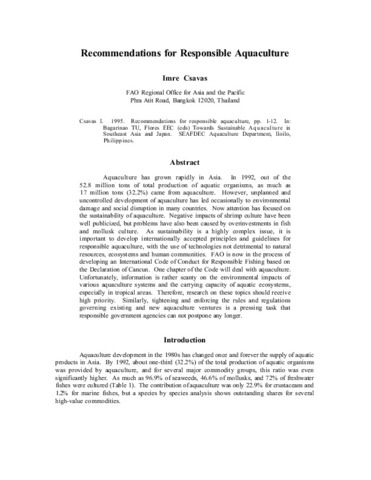
Aquaculture has grown rapidly in Asia. In 1992, out of the 52.8 million tons of total production of aquatic organisms, as much as 17 million tons (32.2%) came from aquaculture. However, unplanned and uncontrolled development of aquaculture has led occasionally to environmental damage and social disruption in many countries. Now attention has focused on the sustainability of aquaculture. Negative impacts of shrimp culture have been well publicized, but problems have also been caused by overinvestments in fish and mollusk culture. As sustainability is a highly complex issue, it is important to develop internationally accepted principles and guidelines for responsible aquaculture, with the use of technologies not detrimental to natural resources, ecosystems and human communities. FAO is now in the process of developing an International Code of Conduct for Responsible Fishing based on the Declaration of Cancun. One chapter of the Code will deal with aquaculture. Unfortunately, information is rather scanty on the environmental impacts of various aquaculture systems and the carrying capacity of aquatic ecosystems, especially in tropical areas. Therefore, research on these topics should receive high priority. Similarly, tightening and enforcing the rules and regulationsgoverning existing and new aquaculture ventures is a pressing task that responsible government agencies can not postpone any longer.
Suggested Citation
Csavas, I. (1995). Recommendations for responsible aquaculture. In T. U. Bagarinao & E. E. C. Flores (Eds.), Towards Sustainable Aquaculture in Southeast Asia and Japan: Proceedings of the Seminar-Workshop on Aquaculture Development in Southeast Asia, Iloilo City, Philippines, 26-28 July, 1994 (pp. 1-12). Tigbauan, Iloilo, Philippines: Aquaculture Department, Southeast Asian Fisheries Development Center.
Chủ thể

Bộ sưu tập
- ADSEA '94 [21]
Related items
Showing items related by title, author, creator and subject.
-
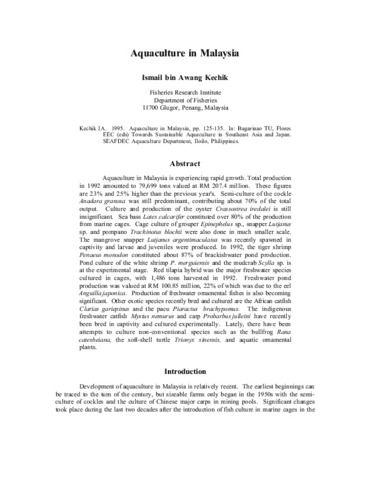
Aquaculture in Malaysia
(Aquaculture Department, Southeast Asian Fisheries Development Center, 1995)Aquaculture in Malaysia is experiencing rapid growth. Total production in 1992 amounted to 79,699 tons valued at RM 207.4 million. These figures are 23% and 25% higher than the previous year's. Semi-culture of the cockle ... -
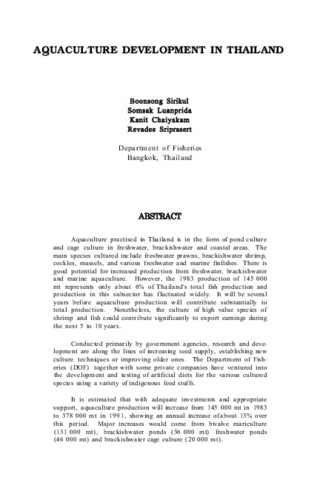
Aquaculture development in Thailand
(Aquaculture Department, Southeast Asian Fisheries Development Center, 1988)Aquaculture practised in Thailand is in the form of pond culture and cage culture in freshwater, brackishwater and coastal areas. The main species cultured include freshwater prawns, brackishwater shrimp, cockles, mussels, ... -
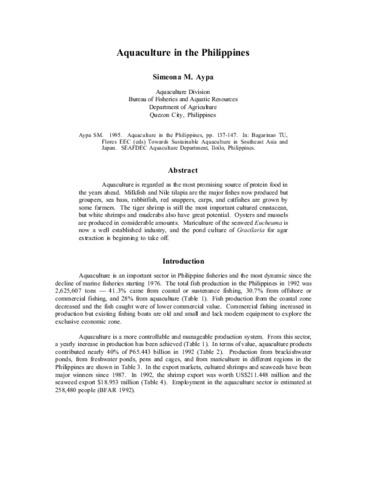
Aquaculture in the Philippines
(Aquaculture Department, Southeast Asian Fisheries Development Center, 1995)Aquaculture is regarded as the most promising source of protein food in the years ahead. Milkfish and Nile tilapia are the major fishes now produced but groupers, sea bass, rabbitfish, red snappers, carps, and catfishes ...