Coastal fisheries and mollusk and seaweed culture in Southeast Asia: Integrated planning and precautions
Share
Abstract
Capture fisheries in Southeast Asia are characterized by rampant overfishing, made worse in many areas by problems of overpopulation and by inappropriate management strategies based on misconceptions about tropical fisheries. Mollusk culture and seaweed culture are frequently cited as means to alleviate fishing pressure and to provide substitute protein. There is great potential for expansion of these types of mariculture in terms of area used, species employed, and products generated. However, large-scale mariculture rarely provides significant employment, and the provision of low-cost protein in markets does not alleviate poverty in countries where food production is the primary means of employment. In cases where conflicts have arisen between mariculture development and ecosystem maintenance, mariculture has been favored by inappropriate economic valuations. Small-scale mariculture designed to provide alternative livelihood for fishers is worth developing, although limited by larval supplies and suitable farming areas. Mariculture should be approached as a species-diverse, small-scale enterprise within the framework of integrated coastal management.
Suggested Citation
McManus, J. W. (1995). Coastal fisheries and mollusk and seaweed culture in Southeast Asia: integrated planning and precautions. In T. U. Bagarinao & E. E. C. Flores (Eds.), Towards Sustainable Aquaculture in Southeast Asia and Japan: Proceedings of the Seminar-Workshop on Aquaculture Development in Southeast Asia, Iloilo City, Philippines, 26-28 July, 1994 (pp. 13-22). Tigbauan, Iloilo, Philippines: Aquaculture Department, Southeast Asian Fisheries Development Center.
Paksa
fishery economics  ; Small scale aquaculture; resource management ; Sociological aspects; integrated coastal zone management ; carrying capacity ; environmental impact ; overfishing ; mollusc culture ; aquaculture ; Catch/effort; sustainability ; aquaculture economics ; Fishery policy; socioeconomic aspects ; aquaculture development ; natural resources ; marine molluscs ; culture effects ; coastal fisheries ; Marine aquaculture; seaweed culture ; fish culture ; Decapoda; Mollusca; South East Asia
; Small scale aquaculture; resource management ; Sociological aspects; integrated coastal zone management ; carrying capacity ; environmental impact ; overfishing ; mollusc culture ; aquaculture ; Catch/effort; sustainability ; aquaculture economics ; Fishery policy; socioeconomic aspects ; aquaculture development ; natural resources ; marine molluscs ; culture effects ; coastal fisheries ; Marine aquaculture; seaweed culture ; fish culture ; Decapoda; Mollusca; South East Asia
Mga koleksyon
- ADSEA '94 [21]
Related items
Showing items related by title, author, creator and subject.
-
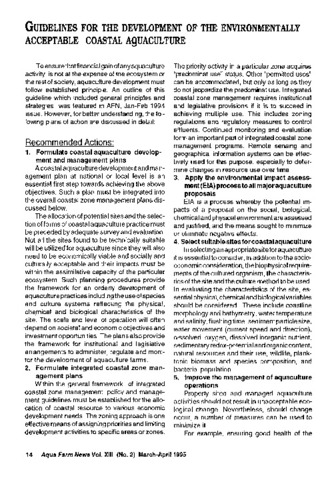
Guidelines for the development of environmentally acceptable coastal aquaculture
(Aquaculture Department, Southeast Asian Fisheries Development Center, 1995)The paper presents some recommendations for the development of the environmentally acceptable coastal aquaculture such as: 1) Formulate coastal aquaculture development and management plans, 2) Formulate integrated coastal ... -
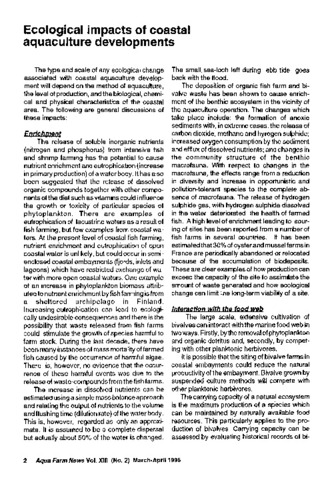
Ecological impacts of coastal aquaculture developments
(Aquaculture Department, Southeast Asian Fisheries Development Center, 1995)The study presents the type and scale of any ecological change associated with coastal aquaculture development. These are enrichment, interaction with the food web, oxygen consumption, disturbance of wildlife and habitat ... -
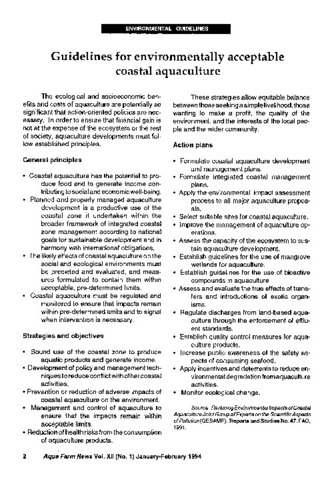
Guidelines for environmentally acceptable coastal aquaculture
(Aquaculture Department, Southeast Asian Fisheries Development Center, 1994)The article discusses the guidelines for environmentally acceptable aquaculture to ensure that financial gain is not at the expense of the ecosystem or the rest of sopciety. The general principles, strategies and objectives, ...