Mechanisms for lake formation in the Philippine archipelago
Share
抄録
Topographic depressions, which when filled with water become lakes, can originate in a number of ways as a result of volcanic processes and activities, crustal and fault movements, stream processes, dissolution of rocks, downslope or mass movements, shoreline processes, glaciation, acolian processes, organic or animal activity and meteorite impacts. Man has also made both intentionally and unintentionally artificial depressions and dams that give rise to man-made lakes. But the mechanisms of formation of most Philippine lakes remain unknown although those of some are well established. Examples are cited in this paper. Lakes with similar mechanisms of formation may possess similar geomorphological, geological, and physico-chemical characteristics.
Directions for Philippine lacustrine research should cover issues on 1) the still unknown origin of most Philippine lakes, 2) assessment of lake-related hazards and risk mitigation in order to reduce disasters, 3) history of climate change as recorded in lacustrine sediments, and 4) policies and strategies for better utilization and development of lake resources which must recognize the truth that lakes are but ephemeral features of the landscape and do not last forever.
記述
Abstract only.
Suggested Citation
Punongbayan, R. S., & Listanco, E. L. (2001). Mechanisms for lake formation in the Philippine archipelago (Abstract only). In C. B. Santiago, M. L. Cuvin-Aralar, & Z. U. Basiao (Eds.), Conservation and Ecological Management of Philippine Lakes in Relation to Fisheries and Aquaculture (p. 149). Tigbauan, Iloilo, Philippines: Aquaculture Department, Southeast Asian Fisheries Development Center; Los Baños, Laguna, Philippines: Philippine Council for Aquatic and Marine Research and Development (PCAMRD), Department of Science and Technology; Quezon City, Philippines: Bureau of Fisheries and Aquatic Resources (BFAR), Department of Agriculture, Quezon City, Philippines.
主題

Related items
Showing items related by title, author, creator and subject.
-
An environmental assessment of the aquaculture potential of Lake Gawaan, Lake Lenneng and Lake Banao/Danum at the Mt. Province
(Aquaculture Department, Southeast Asian Fisheries Development Center; Philippine Council for Aquatic and Marine Research and Development (PCAMRD), Department of Science and Technology; Bureau of Fisheries and Aquatic Resources, 2001)This study reviews the existing conditions of the three Mt. Province lakes: Lake Gawaan, Lake Lenneng and Lake Banao/Danum. Three mechanisms were employed. First is the overview of the resource capabilities. This includes ... -
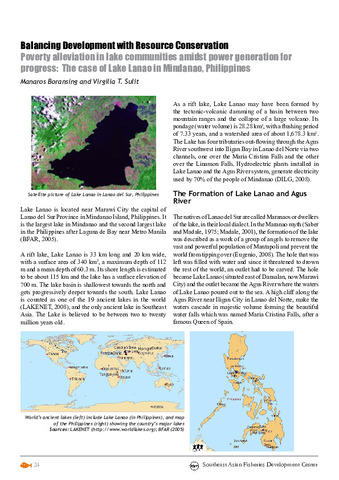
Balancing development with resource conservation poverty alleviation in lake communities amidst power generation for progress: The case of lake Lanao in Mindanao, Philippines
(Secretariat, Southeast Asian Fisheries Development Center, 2009) -
Assessment of local government's implementation of open access policy in Taal Lake, Philippines: Effects on lake conservation and management
(Aquaculture Department, Southeast Asian Fisheries Development Center; Philippine Council for Aquatic and Marine Research and Development (PCAMRD), Department of Science and Technology; Bureau of Fisheries and Aquatic Resources, 2001)The effects of local government's implementation of the current national policy on open access in municipal fisheries are assessed in terms of their impact on the fishery resources of Taal Lake. Local officials and fisherfolk ...