Strategies to reduce disease incidence in mud crab culture
Share
trừu tượng
Mud crab hatchery suffers from low survival due to susceptibility to bacterial infection in the early larval stages among many causes. Despite food safety issues, antibiotics continue to be used in the absence of effective alternatives. In this study, screening of plant extracts was conducted to determine their suitability as antimicrobial agents against pathogens causing low survival in the hatchery. In addition, potential probionts were isolated from the gastrointestinal tract of mud crab, and water and sediments of mud crab grow-out ponds.Crude ethanolic extracts from various terrestrial and mangrove trees were tested for in vitro antimicrobial activity and toxicity to mud crab zoea and megalopa. In addition, the in vivo antimicrobial efficacies of the selected extracts were tested by oral administration followed by experimental challenge with Vibrio harveryi. On the other hand, the putative probionts, were tested for pathogenicity against mud crab zoea and megalopa and quorum sensing inhibition activity against V. harveyi. Finally the extracts and probionts were tested for their efficacy in simulated hatchery and grow-out trials.Results showed that extracts of Terminalia cattapa and the potential probiont Bacillus subtilis G100R11 showed antimicrobial and probiotic activity in in vitro and in vivo tests. In simulated hatchery trials, T. cattapa administration successfully produced crab instar with a survival of 1.3-1.8% in trials 1 and 2 comparable to antibiotic control. B. subtilis produced crab instar with survival of 0.8-1.0% in trials 1 and 2, better than the commercial probiotic with 0-0.13% survival. Using T. cattapa and B. subtilis, survival was above 30% until zoea 5 but suddenly dropped below 5% during metamorphosis to megalopa where high incidence of incomplete molting was observed. If difficulty affecting the molting process is addressed, high survival from zoea to megalopa and crab instar will be achievable.
Sự miêu tả
Abstract only.
Suggested Citation
Amar, E. C., Somera, M. D., Madero, S. B., Tendencia, E. A., & Faisan Jr., J. P. (2017). Strategies to reduce disease incidence in mud crab culture. In E. T. Quinitio, F. D. Parado-Estepa, & R. M. Coloso (Eds.), Philippines : In the forefront of the mud crab industry development : proceedings of the 1st National Mud Crab Congress, 16-18 November 2015, Iloilo City, Philippines (p. 154). Tigbauan, Iloilo, Philippines: Aquaculture Department, Southeast Asian Fisheries Development Center.
Chủ thể
antibiotics  ; bacterial diseases ; bioactive compounds ; crab culture ; developmental stages ; disease control ; growing ponds ; hatcheries; husbandry diseases; larvae ; marine crustaceans ; metamorphosis ; mortality ; moulting ; pond culture ; probiotics ; disease prophylaxis ; survival ; therapy ; zoeae ; Scylla ; Philippines
; bacterial diseases ; bioactive compounds ; crab culture ; developmental stages ; disease control ; growing ponds ; hatcheries; husbandry diseases; larvae ; marine crustaceans ; metamorphosis ; mortality ; moulting ; pond culture ; probiotics ; disease prophylaxis ; survival ; therapy ; zoeae ; Scylla ; Philippines
Taxonomic term

Related items
Showing items related by title, author, creator and subject.
-
Country status of aquatic emergency preparedness and response systems for effective management of aquatic animal disease outbreaks in Myanmar
(Aquaculture Department, Southeast Asian Fisheries Development Center, 2019)Myanmar is one of the OIE members and the Department of Fisheries (DoF) is highly concerned with transboundary aquatic animal pathogens. Therefore, the Aquatic Animal Health & Disease Control Section has already been ... -
Transboundary aquatic animal diseases: History and impacts in ASEAN aquaculture
(Aquaculture Department, Southeast Asian Fisheries Development Center, 2019)Aquaculture is one of the important sectors in the economy of most Asia-Pacific countries. However, majority of aquaculture farms are small-scale and most often lack the necessary facilities to comply with or are not well ... -
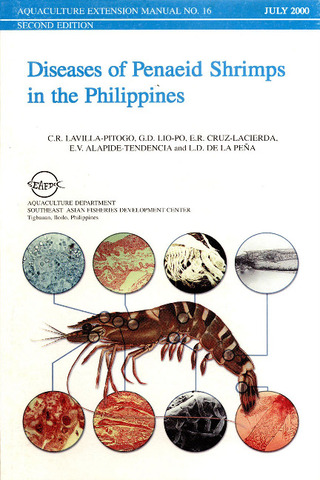
Diseases of penaeid shrimps in the Philippines
(Aquaculture Department, Southeast Asian Fisheries Development Center, 2000)The manual provides information on the diseases that affect the 3 major species of shrimps cultured in the Philippines: Penaeus monodon, P. merguiensis and P. indicus. It includes the common name of the disease, causative ...