Crocodile conservation and breeding management – Issues and constraints: Experience of Myanmar
Share
abstrak
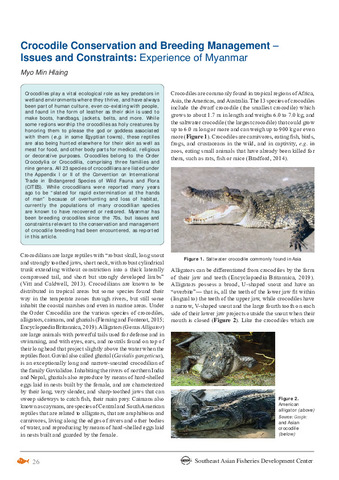
Crocodiles play a vital ecological role as key predators in wetland environments where they thrive, and have always been part of human culture, even co-existing with people, and found in the form of leather as their skin is used to make boots, handbags, jackets, belts, and more. While some regions worship the crocodiles as holy creatures by honoring them to please the god or goddess associated with them (e.g. in some Egyptian towns), these reptiles are also being hunted elsewhere for their skin as well as meat for food, and other body parts for medical, religious or decorative purposes. Crocodiles belong to the Order Crocodylia or Crocodilia, comprising three families and nine genera. All 23 species of crocodilians are listed under the Appendix I or II of the Convention on International Trade in Endangered Species of Wild Fauna and Flora (CITES). While crocodilians were reported many years ago to be “slated for rapid extermination at the hands of man” because of overhunting and loss of habitat, currently the populations of many crocodilian species are known to have recovered or restored. Myanmar has been breeding crocodiles since the 70s, but issues and constraints relevant to the conservation and management of crocodile breeding had been encountered, as reported in this article.
Suggested Citation
Hlaing, M. M. (2019). Crocodile conservation and breeding management – Issues and constraints: Experience of Myanmar. Fish for the People , 17(2), 26-34. http://hdl.handle.net/20.500.12066/5518
Subjek

Koleksi
Related items
Showing items related by title, author, creator and subject.
-
Philippines
(Marine Fishery Resources Development and Management Department, Southeast Asian Fisheries Development Center, 2004)There are five species of sea turtles that occur in the Philippines, namely green hawksbill, olive ridley, loggerhead and leatherback. Several locations for sea turtles nesting are shown in Table 6 (Cruz, 2004). The green ... -
Thailand
(Marine Fishery Resources Development and Management Department, Southeast Asian Fisheries Development Center, 2004)Thailand is located in the middle of the Indochinese Peninsula, between latitudes 5°27' and 20°27’N and longitudes 97°22' and 105°37’E. The Kingdom’s total area is 513,115 square kilometers, of which some 84 percent falls ... -
Myanmar
(Marine Fishery Resources Development and Management Department, Southeast Asian Fisheries Development Center, 2004)Myanmar is situated in the easternmost Indochina Peninsula. It boasts of richly-varied marine resources along extensive coastal shores which can be divided into three regions , namely Rakhine, Ayeyarwaddy and Gulf of Mottama ...