Biological Features of Tuna Catch from Purse Seine of M.V. SEAFDEC Cruise No. 63-1/2001

Share
trừu tượng
This preliminary result is concerning biological features of tuna catches from the first sampling onboard M.V. SEAFDEC. The data analysis of this part would certainly support for the study on by-catch composition of tuna purse seine fisheries within three years study. The length frequency distribution of skipjack and yellowfin tuna are evident as mode more than one cohorts. The relative length-weight was determined using allometric equation for skipjack tuna (W = 8.23185E-06 L3.2319), yellowfin tuna (W = 2.36464E-05 L2.9539), and bigeye tuna (W = 1.8E-05 L3.0431). The skipjack tuna's mean weight was significant heavier than other species at the same length. The size at first maturation was occur at length 64.5 cm. for yellowfin tuna and 63.0 cm. for bigeye tuna and found mature all in skipjack tuna. The number of skipjack and yellowfin males is slightly higher than females but the number of bigeye females was out numbers the males. The female ratio was explain by equation; Rf(L) = 0.7407 - 0.006*L for skipjack tuna and Rf(L) = 1.3764 - 0.0105*L for yellowfin tuna. The largest gonad index was found about 67 in yellowfin tuna but low in number of samples same as bigeye tuna. The small number of samples was effected in some process of reproductive study. However, there was a significant correlation between the variables by the t-test statistic (t0.05).
Suggested Citation
Sukramongkol, N., Kaewnuratchadasorn, P., & Arnupapboon, S. (2002). Biological features of tuna catch from purse seine of M.V. SEAFDEC Cr. 63-1/2001. Samut Prakarn, Thailand: Training Department, Southeast Asian Fisheries Development Center.
Chủ thể
Bộ sưu tập
- SEAFDEC/TD [12]
Related items
Showing items related by title, author, creator and subject.
-
Scientific Report on Stock Assessments of Yellowfin Tuna (Thunnus albacares), Bigeye Tuna (Thunnus obesus) and Skipjack Tuna (Katsuwonus pelamis) in Sulu and Sulawesi Seas by ASPIC
(Training Department, Southeast Asian Fisheries Development Center, 2017-11)Results of stock assessments should be looked at with caution because of following reasons, i.e., (a) Stock assessments (YFT: yellowfin, BET: bigeye and SKJ: skipjack tuna) in the SSS water, may not be meaningful because ... -
Sustainable management of neritic tunas in Southeast Asia: Longtail tuna and kawakawa in focus
(Secretariat, Southeast Asian Fisheries Development Center, 2017)Oceanic and neritic tunas are abundant and commonly found in the waters throughout Southeast Asia. While oceanic tunas migrate over oceans and seas, neritic tunas mostly inhabit the economic zones and subregional marine ... -
Tuna and tuna-like fish resources in the South China Sea and adjacent waters
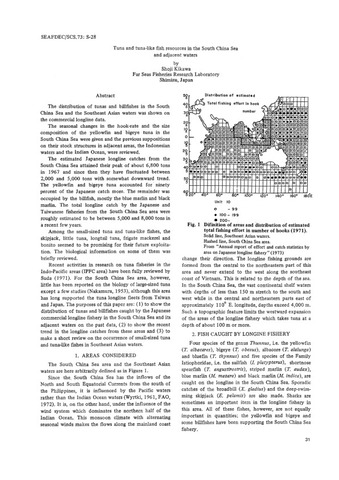
(Japan International Cooperation Agency, 1977)The distribution of tunas and billfishes in the South China Sea and the Southeast Asian waters was shown on the commercial longline data. The seasonal changes in the hook-rate and the size composition of the yellowfin and ...