SEAFDECINSTITUTIONAL REPOSITORY
    • English
    • ไทย
    • 日本語
    • Bahasa Indonesia
    • Bahasa Melayu
    • Burmese
    • Filipino
    • Khmer
    • Lao
    • Tiếng Việt
  • Tiếng Việt 
    • English
    • ไทย
    • 日本語
    • Bahasa Indonesia
    • Bahasa Melayu
    • Burmese
    • Filipino
    • Khmer
    • Lao
    • Tiếng Việt
  • Đăng nhập
Xem mặt hàng 
  •   Trang chủ DSpace
  • 01 SEAFDEC Publications
  • 02 Technical Publications and Reports on Aquaculture
  • AQD Technical Publications and Reports on Aquaculture
  • Proceedings of the First International Conference on the Culture of Penaeid Prawns/Shrimps
  • Xem mặt hàng
  •   Trang chủ DSpace
  • 01 SEAFDEC Publications
  • 02 Technical Publications and Reports on Aquaculture
  • AQD Technical Publications and Reports on Aquaculture
  • Proceedings of the First International Conference on the Culture of Penaeid Prawns/Shrimps
  • Xem mặt hàng
JavaScript is disabled for your browser. Some features of this site may not work without it.

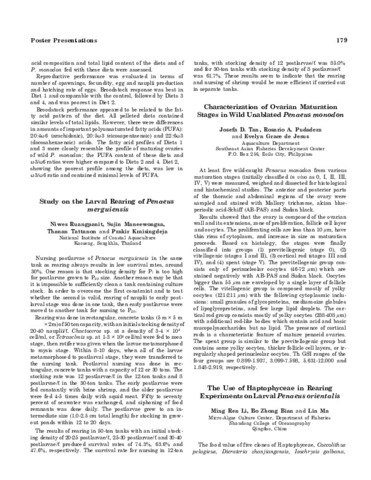
The use of haptophyceae in rearing experiments on larval Penaeus orientalis
Thumbnail
Quan điểm/Open
ficcpps_p179-180.pdf (306.6Kb)
Ngày
1985
Tác giả
Li, M.R.
Bian, B.Z.
Ma, L.
Ma, L.
Page views
522
metadata
Hiển thị bản ghi đầy đủ mặt hàng

Share 
 
trừu tượng
The food value of five clones of Haptophyceae, Coccolithus pelagicus, Dicrateria zhanjiangensis, Isochrysis galbana, Tahitian Isochrysis aff. galbana, and Pseudoisochrysis paradoxa were tested for larval Penaeus orientalis. The algae were semi-continuously cultured in 5,000 ml carboys with 4,000 ml of Guillard f/2 medium, under 2,000 lux continuous light and under aeration. The algal density was up to 1 × 10⁷ cell/ml. Rearing experiments were conducted in round tanks with diameter of 45 cm. Algal density was controlled at 1 × 10⁵ cell/ml in the course of the experiments. The larval density was 18 individual/100 ml; water temperature, 21-24°C; pH, 7.5-7.7; and sea water specific gravity, 1.019.

The results showed that of five clones used, Tahitian I. aff. galbana and D. zhangjiangensis proved to be the best. It took 9-11 days for nauplius I to develop into mysis I with survival rate of 73.5% and 73.4%, respectively.
Sự miêu tả
Abstract only.
URI
http://hdl.handle.net/10862/907
Suggested Citation
Li, M. R., Bian, B. Z., & Ma, L. (1985). The use of haptophyceae in rearing experiments on larval Penaeus orientalis (Abstract only). In Taki Y., Primavera J.H. and Llobrera J.A. (Eds.). Proceedings of the First International Conference on the Culture of Penaeid Prawns/Shrimps, 4-7 December 1984, Iloilo City, Philippines (pp. 179-180). Iloilo City, Philippines: Aquaculture Department, Southeast Asian Fisheries Development Center.
Chủ thể
Diets; Food organism; Rearing; Shrimp culture; Haptophyta; Penaeus orientalis
Bộ sưu tập
  • Proceedings of the First International Conference on the Culture of Penaeid Prawns/Shrimps [79]

© SEAFDEC 2026
Liên hệ chúng tôi


Duyệt qua

Tất cả DSpaceCộng đồng & Bộ sưu tậpTheo ngày phát hànhCác tác giảTiêu đềĐối tượngBộ sưu tập nàyTheo ngày phát hànhCác tác giảTiêu đềĐối tượng

Tài khoản của tôi

Đăng nhập
Related Links
SEAFDEC/TD IRSEAFDEC/AQD IRSEAFDEC/MFRDMD IRSEAFDEC/IFRDMD IR

© SEAFDEC 2026
Liên hệ chúng tôi