Mud crab nursery rearing practices
Share
trừu tượng
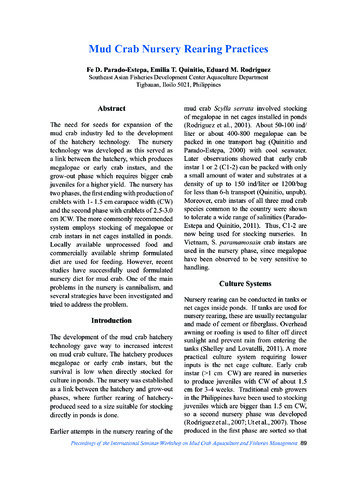
The need for seeds for expansion of the mud crab industry led to the development of the hatchery technology. The nursery technology was developed as this served as a link between the hatchery, which produces megalopae or early crab instars, and the grow-out phase which requires bigger crab juveniles for a higher yield. The nursery has two phases, the first ending with production of crablets with 1- 1.5 cm carapace width (CW) and the second phase with crablets of 2.5-3.0 cm ICW. The more commonly recommended system employs stocking of megalopae or crab instars in net cages installed in ponds. Locally available unprocessed food and commercially available shrimp formulated diet are used for feeding. However, recent studies have successfully used formulated nursery diet for mud crab. One of the main problems in the nursery is cannibalism, and several strategies have been investigated and tried to address the problem.
Suggested Citation
Parado-Estepa, F. D., Quinitio, E. T., & Rodriguez, E. M. (2015). Mud crab nursery rearing practices. In E. T. Quinitio, F. D. Parado-Estepa, Y. C. Thampi Sam Raj, & A. Mandal (Eds.), Proceedings of the International Seminar-Workshop on Mud Crab Aquaculture and Fisheries Management, 10-12 April 2013, Tamil Nadu, India (pp. 89-92). Tamil Nadu, India: Rajiv Gandhi Centre for Aquaculture (MPEDA).
Chủ thể

Related items
Showing items related by title, author, creator and subject.
-
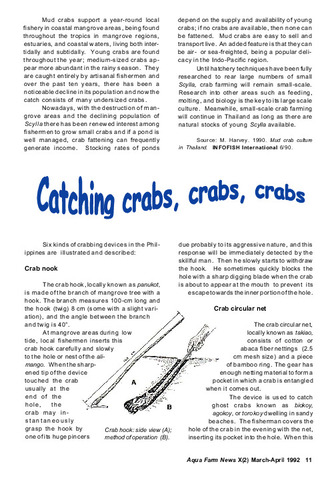
Catching crabs, crabs, crabs
(Aquaculture Department, Southeast Asian Fisheries Development Center, 1992) -
Soft-shell crab production using hatchery-reared mud crab
(Aquaculture Department, Southeast Asian Fisheries Development Center; Philippine Council for Agriculture, Aquatic and Natural Resources Research and Development (PCAARRD), 2015)"The production of soft-shell crabs is well established in other Asian countries but its sustainability is already being threatened due to the decreasing mud crab population in the wild where the seedstocks are sourced. ... -
Monosex culture of the mud crab Scylla serrata at three stocking densities with Gracilaria as crab shelter
(Australian Centre for International Agricultural Research, 1999)The effects of three levels of stocking density (0.5, 1.5 or 3.0/m2) and monosex culture (male or female) on the growth, survival and production of Scylla serrata were investigated. Juvenile crabs were stocked in 150 m2 ...