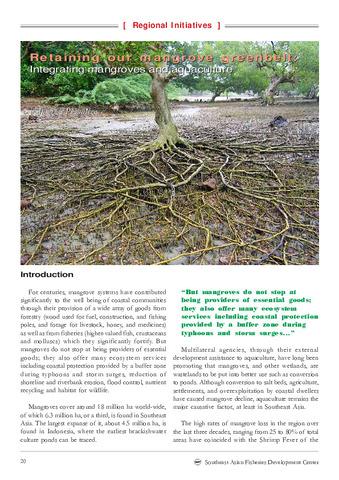
Retaining our mangrove greenbelt: Integrating mangroves and aquaculture
Share
Abstract
Although multilateral agencies in Southeast Asia have long been promoting that mangroves, and other wetlands, are wastelands to be put into better use, such as conversion to ponds. However, there is a need for Mangrove Friendly Aquaculture (MFA) technology in the intertidal forest, or swamp, which does not require the clearing of trees. MFA may be defined on 2 levels: 1) silvofisheries or aquasilviculture, where the low density culture of crabs, shrimps and fish is integrated with mangroves; and, 2) mangrove filters where mangrove forests are used to absorb the excess nutrients in the effluents from high-density culture ponds. A review is made of MFA practices belonging to the first category. Discussion is on a country basis, moving from traditional systems in Indonesia, to the introduced technologies in Indonesia, Vietnam, the Philippines and Malaysia. It is hoped that this review will be of use to scientists, aquaculturists, policy makers and governmental/NGOs interested in making aquaculture more ecologically sound and socially responsible.
Suggested Citation
Primavera, J. (2004). Retaining our mangrove greenbelt: Integrating mangroves and aquaculture. Fish for the People , 2(3), 20-26. http://hdl.handle.net/20.500.12066/694
Paksa

Mga koleksyon
Related items
Showing items related by title, author, creator and subject.
-
Paradigm shifts in mangrove rehabilitation in Southeast Asia: Focus on the Philippines
(Department of Environment and Natural Resources - Ecosystems Research and Development Bureau (DENR-ERDB), 2014)Mangrove rehabilitation has a long history in the Philippines dating back to the 1930s. The standard practice is the planting of bakhaw Rhizophora propagules by paid community members (or volunteers) in seafront sites ... -
Guidelines for the development of environmentally acceptable coastal aquaculture
(Aquaculture Department, Southeast Asian Fisheries Development Center, 1995)The paper presents some recommendations for the development of the environmentally acceptable coastal aquaculture such as: 1) Formulate coastal aquaculture development and management plans, 2) Formulate integrated coastal ... -
Mudcrab culture in mangrove areas: AQD verifies culture technique
(Aquaculture Department, Southeast Asian Fisheries Development Center, 1997)