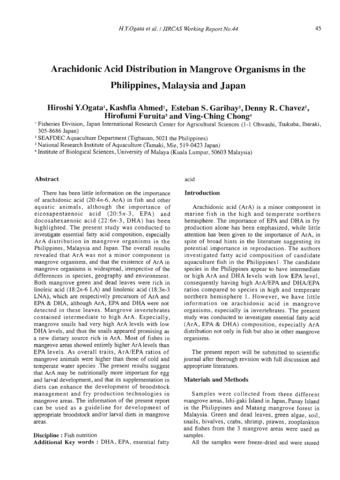
Arachidonic acid distribution in mangrove organisms in the Philippines, Malaysia and Japan
Share
trừu tượng
There has been little information on the importance of arachidonic acid (20:4n-6, ArA) in fish and other aquatic animals, although the importance of eicosapentaenoic acid (20:5n-3, EPA) and docosahexaenoic acid (22:6n-3, DHA) has been highlighted. The present study was conducted to investigate essential fatty acid composition, especially ArA distribution in mangrove organisms in the Philippines, Malaysia and Japan. The overall results revealed that ArA was not a minor component in mangrove organisms, and that the existence of ArA in mangrove organisms is widespread, irrespective of the differences in species, geography and environment. Both mangrove green and dead leaves were rich in linoleic acid (18:2n-6 LA) and linolenic acid (18:3n-3 LNA), which are respectively precursors of ArA and EPA & DHA, although ArA, EPA and DHA were not detected in these leaves. Mangrove invertebrates contained intermediate to high ArA. Especially, mangrove snails had very high ArA levels with low DHA levels, and thus the snails appeared promising as a new dietary source rich in ArA. Most of fishes in mangrove areas showed entirely higher ArA levels than EPA levels. As overall traits, ArA/EPA ratios of mangrove animals were higher than those of cold and temperate water species .The present results suggest that ArA may be nutritionally more important for egg and larval development, and that its supplementation in diets can enhance the development of broodstock management and fry production technologies in mangrove areas. The information of the present report can be used as a guideline for development of appropriate broodstock and/or larval diets in mangrove areas.
Keywords
DHA EPA essential fatty acidChủ thể


Bộ sưu tập
Related items
Showing items related by title, author, creator and subject.
-
Advanced broodstock diets for the mangrove red snapper and a potential importance of arachidonic acid in eggs and fry
(Springer Verlag, 2003)Mangrove red snapper fed advanced broodstock diets containing squid meal and squid oil exhibited higher hatching rates, cumulative survival and survival activity index than those fed a basal diet or a basal diet supplemented ... -
Evaluation of dietary freeze-dried Chaetoceros calcitrans supplementation to control Vibrio harveyi infection on Penaeus monodon juvenile
(Elsevier, 2014)Effects of supplementation of diets with freeze-dried Chaetoceros calcitrans to control Vibrio harveyi infection are evaluated through immune responses, and disease resistance of juvenile Penaeus monodon. Total lipid and ... -
Philippine thraustochytrids from mangroves: A rich new source of essential fatty acids for human nutrition
(Marine Science Institute, University of the Philippines, 2007)