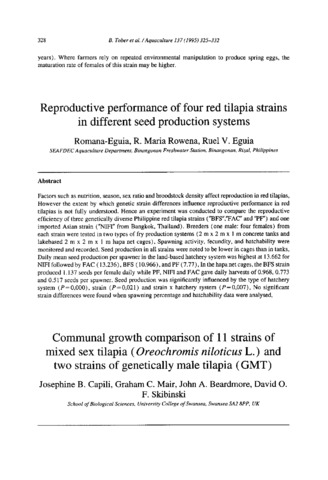
Reproductive performance of four red tilapia strains in different seed production systems
Share
Abstract
Factors such as nutrition, season, sex ratio and broodstock density affect reproduction in red tilapias. However the extent by which genetic strain differences influence reproductive performance in red tilapias is not fully understood. Hence an experiment was conducted to compare the reproductive efficiency of three genetically diverse Philippine red tilapia strains (“BFS”, “FAC” and “PP’) and one imported Asian strain (“NIFI” from Bangkok, Thailand). Breeders (one male: four females) from each strain were tested in two types of fry production systems (2 m x 2 m x 1 m concrete tanks and lake based 2 m x 2 m x 1 m hapa net cages). Spawning activity, fecundity, and hatchability were monitored and recorded. Seed production in all strains were noted to be lower in cages than in tanks. Daily mean seed production per spawner in the land-based hatchery system was highest at 13.662 for NIFI followed by FAC ( 13.236), BFS (10.966), and PF (7.77). In the hapa net cages, the BFS strain produced 1.137 seeds per female daily while PF, NIFI and FAC gave daily harvests of 0.968, 0.773 and 0.517 seeds per spawner. Seed production was significantly influenced by the type of hatchery system (P = 0,000) , strain (P = 0,021) and strain x hatchery system (P = 0,007), No significant strain differences were found when spawning percentage and hatchability data were analysed.
Description
Abstract only.
Suggested Citation
Romana-Eguia, M. R. R., & Eguia, R. V. (1995). Reproductive performance of four red tilapia strains in different seed production systems. Aquaculture , 137(1-4), 328. https://doi.org/10.1016/0044-8486(96)83586-1
Subject
Koleksi
- AQD Journal Articles [1249]
Related items
Showing items related by title, author, creator and subject.
-
Vibrio load and percentage composition of sucrose‐fermenting vibrios in Nile tilapia (Oreochromis niloticus) cultured in brackish water earthen ponds and biocontrol potential of recycled tilapia‐conditioned greenwater against population growth of V. parahaemolyticus and non‐sucrose‐fermenting vibrios in the grow‐out culture of white leg shrimp (Litopenaeus vannamei)
(Wiley, 2022-10-20)Vibrio are known opportunistic pathogens of pond-cultured fish and shrimp. This study determined the presumptive Vibrio count (PVC) and percentage composition of “beneficial” sucrose-fermenting vibrios (SFVs) ... -
Antibacterial activity of tilapia Tilapia hornorum against Vibrio harveyi
(Elsevier, 2004)Disease due to luminous Vibrio has been a major problem of the shrimp industry. Different technologies have been introduced to control the disease. One of the techniques reported to work against luminous bacteria in the ... -
An investigation of enzyme and other protein polymorphisms in Japanese stocks of the tilapias Oreochromis niloticus and Tilapia zillii
(Elsevier, 1984)Samples of Oreochromis niloticus and Tilapia zillii were collected from the hatcheries of Osaka Prefecture Fisheries Experimental Station and Shiga Prefecture Fisheries Experimental Station, Japan, respectively. The samples ...