Development of aquaculture techniques on new aquatic species to create and promote a local aquaculture industry in Southeast Asia

Share
trừu tượng
Aquaculture achieved a significant milestone in 2022, surpassing capture fisheries production as the leading aquatic producer. Its global production reached 130.9 million t, with 94.4 million t comprising aquatic animals, marking a 4.4 % surge from 2020 (FAO, 2024). This milestone, coupled with the decline of capture fishery production due to overexploitation and overfishing, underscores the need to explore and develop aquaculture techniques for new aquatic species. Once established, these techniques will be promoted and hopefully create a new local aquaculture industry in Southeast Asia.
Recognizing the unparalleled success and expertise of the Aquaculture Department of the Southeast Asian Fisheries Development Center (SEAFDEC/AQD) in the development of aquaculture technologies, especially in the broodstock management, spawning, larval rearing, nursery and grow-out culture, fish nutrition, and fish health management, this study, with funding support from the Japanese Trust Fund (JTF), aims to develop aquaculture techniques for new aquatic species, namely: slipper lobster (Thenus orientalis), kawakawa (Euthynnus affinis), and shortfin scad (Decapterus macrosoma). Furthermore, this study was conducted to generate basic information on reproductive biology, breeding, farming techniques, feeding habits, fish health, and other relevant data for developing aquaculture techniques of the three species through the collection from identified sites, transport, stocking, and management of broodstock, larval rearing, feeding, and health management experiments.
Suggested Citation
Cabanilla-Legaspi, M. I., Buen-Ursua, S. M., Ito, S., Peña, L. d. l., & Tupas-Bautista, R. (2024). Development of aquaculture techniques on new aquatic species to create and promote a local aquaculture industry in Southeast Asia. Fish for the People , 22(3), 14-21. http://hdl.handle.net/20.500.12066/7577
Chủ thể
Bộ sưu tập
Related items
Showing items related by title, author, creator and subject.
-
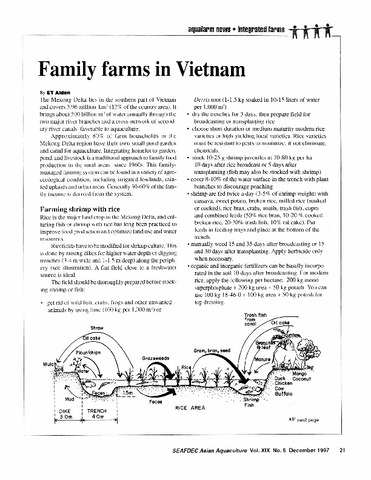
Family farms in Vietnam
(Aquaculture Department, Southeast Asian Fisheries Development Center, 1997) -
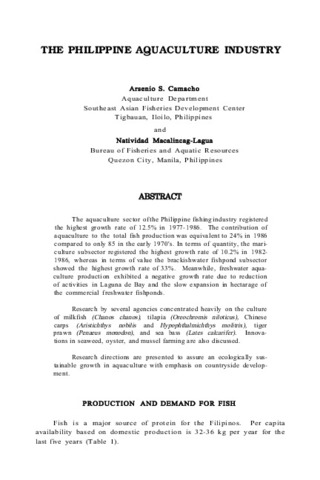
The Philippine aquaculture industry
(Aquaculture Department, Southeast Asian Fisheries Development Center, 1988)The aquaculture sector of the Philippine fishing industry registered the highest growth rate of 12.5% in 1977-1986. The contribution of aquaculture to the total fish production was equivalent to 24% in 1986 compared to ... -
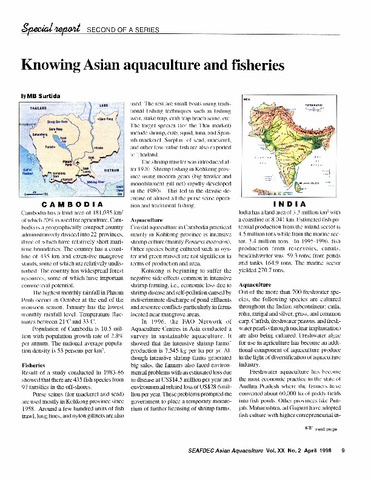
Knowing Asian aquaculture and fisheries
(Aquaculture Department, Southeast Asian Fisheries Development Center, 1998-04)This article is the second of four parts.