
Fish for the People Vol.24 No.1
Share
trừu tượng
Co-management of fishery resources fosters a collaborative environment where every stakeholder, from resource users to government authorities, takes part and share responsibilities related to information, decision-making and implementation. In practice, however, power sharing can vary significantly. The integration of the ecosystem approach to fisheries management (EAFM), which looks at fisheries management as a whole ecosystem, where ecological, social and governance are considered, complements the fisheries co-management approach. To ensure management strategies are effective and context specific, the use of SWOT analysis is recommended during the planning phase to identify strengths and challenges unique to the area. This collaborative model can help enhance the livelihoods of small-scale fishing communities and promote sustainability through collective action.
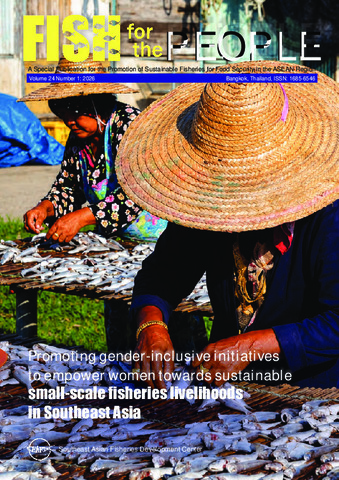
Women comprise nearly half of the small-scale capture fisheries workforce. Despite this, their contributions have remained “invisible,” and they continue to face an uphill battle in terms of participation in decision-making as well as access to resources and financial services. Traditional gender stereotypes and a lack of confidence due to skills gaps continue to limit women’s participation in leadership roles and capacity-building activities. SEAFDEC, at the forefront of mainstreaming gender equality in fisheries in the Southeast Asian region, has made gender a cross-cutting issue in its Plan of Action on Sustainable Fisheries for Food Security Towards 2030. Collaborative projects, such as the one with FAO and several Member Countries (Lao PDR, Myanmar, the Philippines, and Thailand), help ensure that both men and women have equal opportunities to shape policies that sustain their livelihoods.