
Matching-up the population dynamics of mekong giant catfish with conservation and management strategies
Share
Abstract
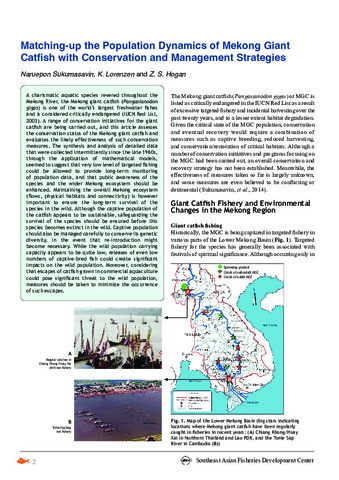
A charismatic aquatic species revered throughout the Mekong River, the Mekong giant catfish (Pangasianodon gigas) is one of the world's largest freshwater fishes and is considered critically endangered (IUCN Red List, 2003). A range of conservation initiatives for the giant catfish are being carried out, and this article assesses the conservation status of the Mekong giant catfish and evaluates the likely effectiveness of such conservation measures. The synthesis and analysis of detailed data that were collected intermittently since the late 1960s, through the application of mathematical models, seemed to suggest that very low level of targeted fishing could be allowed to provide long-term monitoring of population data, and that public awareness of the species and the wider Mekong ecosystem should be enhanced. Maintaining the overall Mekong ecosystem (flows, physical habitats and connectivity) is however important to ensure the long-term survival of the species in the wild. Although the captive population of the catfish appears to be sustainable, safeguarding the survival of the species should be ensured before this species becomes extinct in the wild. Captive population should also be managed carefully to conserve its genetic diversity, in the event that re-introduction might become necessary. While the wild population carrying capacity appears to be quite low, releases of even low numbers of captive-bred fish could create significant impacts on the wild population. Moreover, considering that escapes of catfish grown in commercial aquaculture could pose significant threat to the wild population, measures should be taken to minimize the occurrence of such escapes.
Suggested Citation
Sukumasavin, N., Lorenzen, K., & Hogan, Z. S. (2015). Matching-up the population dynamics of mekong giant catfish with conservation and management strategies. Fish for the People , 13(3), 2-11. http://hdl.handle.net/20.500.12066/971
