Milkfish culture and artificial propagation
Share
ບົດຄັດຫຍໍ້
Milkfish (Chanos chanos Forsskal) is widely distributed in the Indo-Pacific region and one of the most extensively cultured fish in Southeast Asia. In the Philippines, Indonesia and Taiwan, over 400,000 hectares of brackishwater ponds and freshwater bodies are used to culture milkfish for food and as baitfish.
In recent years, various culture methods have been developed to increase production per unit pond area. These include: 1) improved methods of pond fertilization, 2) stock manipulation, 3) adoption of deepwater pond systems and 4) supplemental feeding.
Fry needed to stock milkfish ponds come largely from the wild. Fluctuation in fry supply due to seasonal, climatic and biological factors however has been partly responsible for the slow growth of the milkfish industry. To augment and stabilize the fry supply, efforts to breed milkfish in captivity were initiated in several institutions. These efforts have resulted in: (1) development of induced spawning techniques by hypophysation and administration of gonadotropin-releasing hormone analogues (GnRH-A); (2) spontaneous maturation and spawning of captive milkfish; (3) hormonal induction of gonad development; and (4) development of larval rearing techniques.
While milkfish culture has considerably improved and artificial propagation has been achieved, numerous problems still have to be addressed particularly those related to (1) the development of new culture techniques and (2) controlled breeding.

Taxonomic term

Collections
Related items
Showing items related by title, author, creator and subject.
-
Small-scale freshwater aquaculture development: Experiences from the Philippines on giant freshwater prawn, milkfish and tilapia
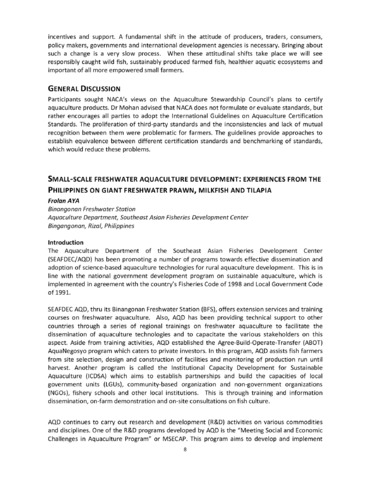
(Japan International Cooperation Agency, 2013-12)The Aquaculture Department of the Southeast Asian Fisheries Development Center (SEAFDEC/AQD) has been promoting a number of programs towards effective dissemination and adoption of science-based aquaculture technologies ... -
Economic value of the milkfish industry
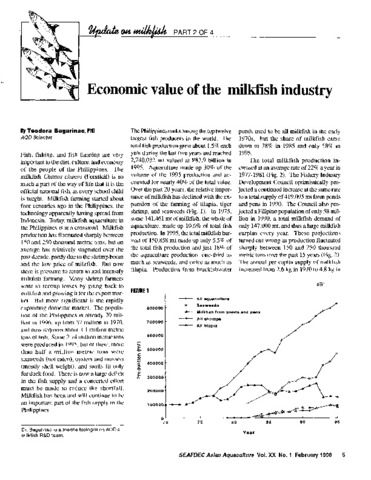
(Aquaculture Department, Southeast Asian Fisheries Development Center, 1998)A brief description is given of the milkfish (Chanos chanos) farming industry in the Philippines. Over the past 20 years, the relative importance of milkfish has declined with the expansion of tilapia, tiger shrimp and ... -
Milkfish ponds from mangroves
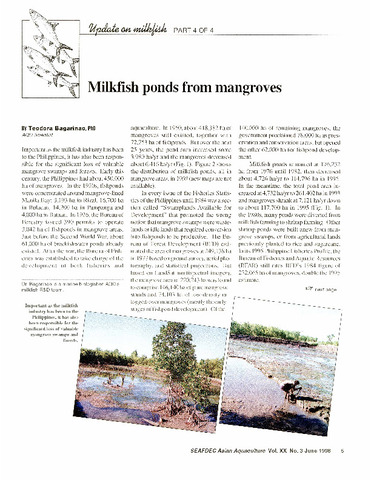
(Aquaculture Department, Southeast Asian Fisheries Development Center, 1998)