SEAFDECINSTITUTIONAL REPOSITORY
    • English
    • ไทย
    • 日本語
    • Bahasa Indonesia
    • Bahasa Melayu
    • Burmese
    • Filipino
    • Khmer
    • Lao
    • Tiếng Việt
  • Filipino 
    • English
    • ไทย
    • 日本語
    • Bahasa Indonesia
    • Bahasa Melayu
    • Burmese
    • Filipino
    • Khmer
    • Lao
    • Tiếng Việt
  • Mag log in
Tingnan ang Item 
  •   DSpace Home
  • 01 SEAFDEC Publications
  • 12 Journals/ Magazines
  • Aqua Farm News
  • Tingnan ang Item
  •   DSpace Home
  • 01 SEAFDEC Publications
  • 12 Journals/ Magazines
  • Aqua Farm News
  • Tingnan ang Item
JavaScript is disabled for your browser. Some features of this site may not work without it.

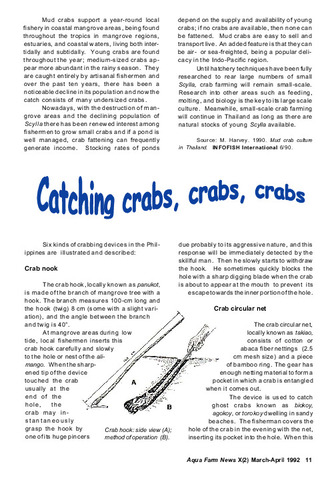
Catching crabs, crabs, crabs
Thumbnail
Tingnan/Open
AFNv10n02pp11-13.pdf (209.0Kb)
Petsa
1992
May-akda
Castaños, Milagros T.
Southeast Asian Fisheries Development Center, Aquaculture Department
Page views
770
Metadata
Ipakita ang buong tala ng item

Share 
 
URI
http://hdl.handle.net/10862/2592
Suggested Citation
Southeast Asian Fisheries Development Center, Aquaculture Department (1992). Catching crabs, crabs, crabs. Aqua Farm News, 10(2), 11-13. http://hdl.handle.net/10862/2592
Paksa
brackishwater environment ASFA; Catching methods; crab fisheries ASFA; fishing gear ASFA; fishing nets ASFA; grappling gear ASFA; trap nets ASFA; Scylla serrata
Taxonomic term
Scylla serrata GBIF
Mga koleksyon
  • Aqua Farm News [286]

Related items

Showing items related by title, author, creator and subject.

  • Thumbnail

    Soft-shell crab production using hatchery-reared mud crab 

    Tobias-Quinitio, Emilia J.; Libunao, Gardel Xyza S.; Parado-Estepa, Fe D.; Calpe, Adelaida T. (Aquaculture Department, Southeast Asian Fisheries Development Center; Philippine Council for Agriculture, Aquatic and Natural Resources Research and Development (PCAARRD), 2015)
    "The production of soft-shell crabs is well established in other Asian countries but its sustainability is already being threatened due to the decreasing mud crab population in the wild where the seedstocks are sourced. ...
  • Thumbnail

    Monosex culture of the mud crab Scylla serrata at three stocking densities with Gracilaria as crab shelter 

    Triño, Avelino T.; Millamena, Oseni M.; Keenan, Clive P. (Australian Centre for International Agricultural Research, 1999)
    The effects of three levels of stocking density (0.5, 1.5 or 3.0/m2) and monosex culture (male or female) on the growth, survival and production of Scylla serrata were investigated. Juvenile crabs were stocked in 150 m2 ...
  • Thumbnail

    Soft-shell crab production using hatchery-produced mangrove crab Scylla serrata juveniles 

    Ganesh, K.; Dinakaran, G. K.; Sundaresan, T.; Satheesh Kumar, K.; Gangadharan, K. V.; Viswanathan, S.; Pandiarajan, S.; Thampi Sam Raj, Yohannan C. (Rajiv Gandhi Centre for Aquaculture (MPEDA), 2015)
    Soft-shell crab production is being practiced in many Asian countries but the major source of seedstock is from the wild, which could no longer sustain the increasing demand. Commercial scale soft-shell crab production can ...
© SEAFDEC 2025
Makipag-ugnayan sa amin


Mag-browse

Lahat ng DSpaceMga Komunidad at KoleksyonAyon sa Petsa ng IsyuMga may-akdaMga pamagatMga paksaAng Koleksyon na itoAyon sa Petsa ng IsyuMga may-akdaMga pamagatMga paksa

Aking Account

Mag log in
Related Links
SEAFDEC/TD IRSEAFDEC/AQD IRSEAFDEC/MFRDMD IRSEAFDEC/IFRDMD IR

© SEAFDEC 2025
Makipag-ugnayan sa amin