Distribution pattern of shrimps and fish among Avicennia and Rhizophora microhabitats in the Pagbilao mangroves, Philippines
Share
Abstract
For sustainable management of mangrove ecosystems, there is a pressing need to increase our knowledge of fish and invertebrates associated with this system. This study sampled microhabitats (89–258 m2) inside the mangrove forest at Pagbilao, the Philippines, on two consecutive spring tides using stake nets. Distribution patterns of shrimps and fish were compared among four microhabitats that differed in dominant mangrove species (Avicennia marina, A. officinalis or Rhizophora apiculata), structural complexity of the root system, and proximity to open water habitat. A 5 to 6-year-old replanted Rhizophora microhabitat was also sampled to study faunal recolonization following replantation. The mean (±SE) density of the shrimp community was 1·5±0·2 shrimps m−2, dominated by Palaemonidae, followed by Acetes sp., Penaeus merguiensis and Metapenaeus ensis . The highest shrimp density was observed in the replanted Rhizophora habitat, which also had the highest structural complexity. The mean (±SE) density and biomass of the fish community was 5·1±2·0 fish m−2and 10·4±3·3 g m−2, respectively, dominated by Ambassis kopsi, A. urotaenia and Atherinomorus balabacensis. The fish community preferred the pneumatophore (Avicennia) microhabitats to the prop root (Rhizophora) habitats. Highest fish abundance and biomass were observed in the most inland habitat, which also lacked larger (total length >100 mm) carnivorous fish. The results demonstrate the extensive use of intertidal mangrove forests by vagile fauna, as well as the successful recolonization by shrimps and fish of replanted Rhizophora habitat. The role of mangroves as predation refuges, based on the distribution pattern of shrimps and fish, is discussed. Sampling strategies in mangrove intertidal habitat are also outlined.
Suggested Citation
Rönnbäck, P., Troell, M., Kautsky, N., & Primavera, J. (1999). Distribution pattern of shrimps and fish among Avicennia and Rhizophora microhabitats in the Pagbilao mangroves, Philippines. Estuarine, Coastal and Shelf Science , 48(2), 223-234. https://doi.org/10.1006/ecss.1998.0415
Paksa
biotic factors; ecological distribution; habitat selection; mangrove swamps; microhabitat; predators; protective behaviour; mangroves; fish; Atherinomorus balabacensis; Metapenaeus ensis; Palaemonidae; Penaeus merguiensis; Rhizophora apiculata; Philippines, Pagbilao; Distribution pattern; Penaeid shrimp; Root complexity; Predation refuge; Sampling strategies; Philippines
Taxonomic term
Mga koleksyon
- AQD Journal Articles [1249]
Related items
Showing items related by title, author, creator and subject.
-
Paradigm shifts in mangrove rehabilitation in Southeast Asia: Focus on the Philippines
(Department of Environment and Natural Resources - Ecosystems Research and Development Bureau (DENR-ERDB), 2014)Mangrove rehabilitation has a long history in the Philippines dating back to the 1930s. The standard practice is the planting of bakhaw Rhizophora propagules by paid community members (or volunteers) in seafront sites ... -
A review of mangrove rehabilitation in the Philippines: successes, failures and future prospects
(Springer, 2008)From half a million hectares at the turn of the century, Philippine mangroves have declined to only 120,000 ha while fish/shrimp culture ponds have increased to 232,000 ha. Mangrove replanting programs have thus been ... -
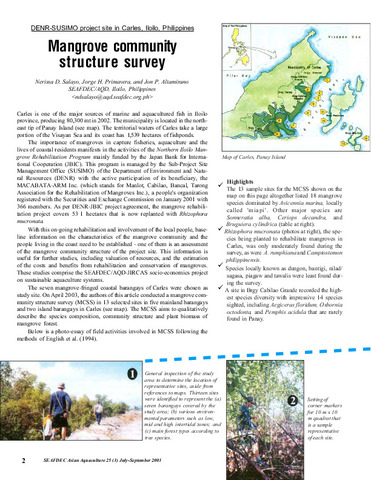
Mangrove community structure survey
(Aquaculture Department, Southeast Asian Fisheries Development Center, 2003)Highlights are given of a mangrove community structure survey conducted in the coastal barangays of Carles, Panay Island, Philippines, in April 2003. The survey aimed to qualitatively describe the species composition, ...