Aquaculture system
Share
ບົດຄັດຫຍໍ້
A defining moment in the development of aquaculture was the demonstration that fish could be induced to spawn artificially. This finding, elaborated in Brazil in 1934, drove aquaculture forward by eliminating the need to collect wild seed or broodstock. This freedom brought about the revolution that was needed to support the rapid growth of the industry on a global scale. The development of methods for rearing larvae and controlling the reproductive cycle of aquatic species in general has created a hugely diverse industry of significant economic value. As researchers have discovered more about the life cycles of cultured aquatic organisms and the stimuli that encourage their development, aquaculturists have adapted their systems to gain greater control over production-related factors: growth, sexual maturation, reproduction, disease control and immunology. More recent has been the trend towards ensuring the safety and quality of the final product as well as developments in the culture of novel, non-food organisms. Today, aquaculture is practiced in fresh, brackish, and marine waters, in tropical through arctic conditions, in inland lakes and ponds through to large offshore cage operations. [Extract]
Suggested Citation
Choomthi, A. (2008). Aquaculture system. In Handbook on Community-based Aquaculture for Remote Rural Areas of Southeast Asia (pp. 77-103). Bangkok, Thailand: Secretariat, Southeast Asian Fisheries Development Center.
ວິຊາ
aquaculture  ; pond culture ; ponds ; pond construction ; liming ; organic fertilizers ; fertilizers ; stocking density ; cage culture ; feeding ; Rice field aquaculture; embankments ; refuges ; stocking (organisms) ; harvesting ; agropisciculture ; aquaculture techniques ; aquaculture systems ; South East Asia
; pond culture ; ponds ; pond construction ; liming ; organic fertilizers ; fertilizers ; stocking density ; cage culture ; feeding ; Rice field aquaculture; embankments ; refuges ; stocking (organisms) ; harvesting ; agropisciculture ; aquaculture techniques ; aquaculture systems ; South East Asia
Related items
Showing items related by title, author, creator and subject.
-
The Philippines recommends for tilapia
(DOST-PCAARRD, 2018)Tilapia is one of the most commercially important commodities in fisheries and aquaculture. Although tilapia is relatively easy to propagate and culture, the Philippine tilapia industry needs the necessary boost in the ... -
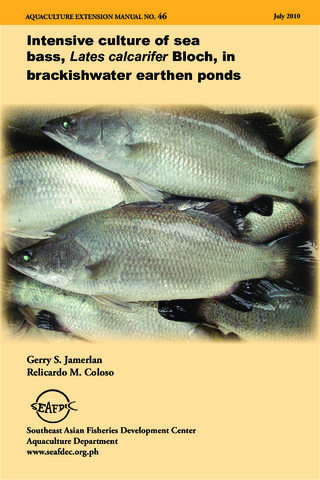
Intensive culture of sea bass, Lates calcarifer Bloch, in brackishwater earthen ponds
(Aquaculture Department, Southeast Asian Fisheries Development Center, 2010)An extension manual describing criteria for site selection, monoculture and polyculture operations including feeds and feeding, harvest, common diseases, economic analysis. -
The Philippine aquaculture industry
(Aquaculture Department, Southeast Asian Fisheries Development Center, 1988)The aquaculture sector of the Philippine fishing industry registered the highest growth rate of 12.5% in 1977-1986. The contribution of aquaculture to the total fish production was equivalent to 24% in 1986 compared to ...