Developments in integrated aquaculture in Southeast Asia
Share
Abstract
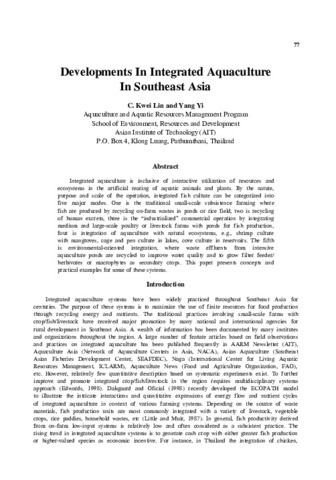
Integrated aquaculture is inclusive of interactive utilization of resources and ecosystems in the artificial rearing of aquatic animals and plants. By the nature, purpose and scale of the operation, integrated fish culture can be categorized into five major modes. One is the traditional small-scale subsistence farming where fish are produced by recycling on-farm wastes in ponds or rice field, two is recycling of human excreta, three is the industrialized commercial operation by integrating medium and large-scale poultry or livestock farms with ponds for fish production, four is integration of aquaculture with natural ecosystems, e.g., shrimp culture with mangroves, cage and pen culture in lakes, cove culture in reservoirs. The fifth is environmental-oriented integration, where waste effluents from intensive aquaculture ponds are recycled to improve water quality and to grow filter feeder/ herbivores or macrophytes as secondary crops. This paper presents concepts and practical examples for some of these systems.
Suggested Citation
Lin, C. K., & Yi, Y. (2001). Developments in integrated aquaculture in Southeast Asia. In L. M. B. Garcia (Ed.), Responsible Aquaculture Development in Southeast Asia. Proceedings of the Seminar-Workshop on Aquaculture Development in Southeast Asia organized by the Aquaculture Department, Southeast Asian Fisheries Development Center, 12-14 October 1999, Iloilo City, Philippines (pp. 77-88). Tigbauan, Iloilo, Philippines: Aquaculture Department, Southeast Asian Fisheries Development Center.
Paksa

Mga koleksyon
- ADSEA '99 [21]
Related items
Showing items related by title, author, creator and subject.
-
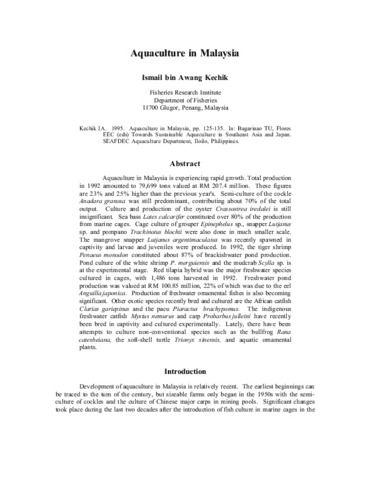
Aquaculture in Malaysia
(Aquaculture Department, Southeast Asian Fisheries Development Center, 1995)Aquaculture in Malaysia is experiencing rapid growth. Total production in 1992 amounted to 79,699 tons valued at RM 207.4 million. These figures are 23% and 25% higher than the previous year's. Semi-culture of the cockle ... -
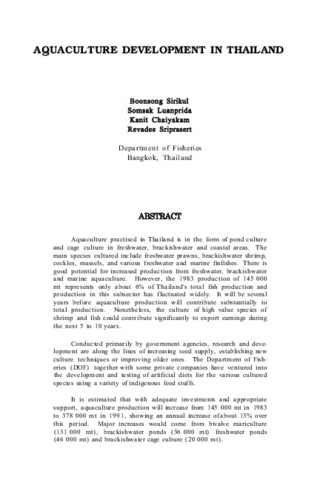
Aquaculture development in Thailand
(Aquaculture Department, Southeast Asian Fisheries Development Center, 1988)Aquaculture practised in Thailand is in the form of pond culture and cage culture in freshwater, brackishwater and coastal areas. The main species cultured include freshwater prawns, brackishwater shrimp, cockles, mussels, ... -
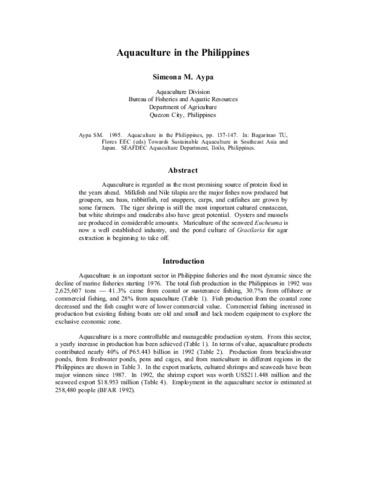
Aquaculture in the Philippines
(Aquaculture Department, Southeast Asian Fisheries Development Center, 1995)Aquaculture is regarded as the most promising source of protein food in the years ahead. Milkfish and Nile tilapia are the major fishes now produced but groupers, sea bass, rabbitfish, red snappers, carps, and catfishes ...