High throughput RNA sequencing reveals temperature tolerance mechanisms in Scylla serrata
Share
นามธรรม
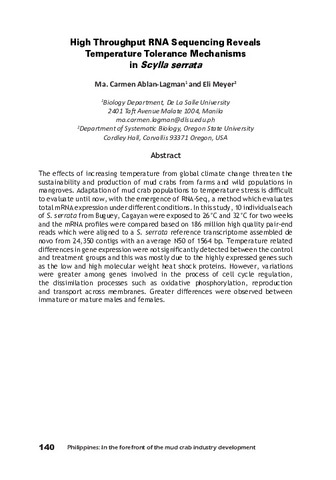
The effects of increasing temperature from global climate change threaten the sustainability and production of mud crabs from farms and wild populations in mangroves. Adaptation of mud crab populations to temperature stress is difficult to evaluate until now, with the emergence of RNA-Seq, a method which evaluates total mRNA expression under different conditions. In this study, 10 individuals each of S. serrata from Buguey, Cagayan were exposed to 26~’C and 32~’C for two weeks and the mRNA profiles were compared based on 186 million high quality pair-end reads which were aligned to a S. serrata reference transcriptome assembled de novo from 24,350 contigs with an average N50 of 1564 bp. Temperature related differences in gene expression were not significantly detected between the control and treatment groups and this was mostly due to the highly expressed genes such as the low and high molecular weight heat shock proteins. However, variations were greater among genes involved in the process of cell cycle regulation, the dissimilation processes such as oxidative phosphorylation, reproduction and transport across membranes. Greater differences were observed between immature or mature males and females.
Description
Abstract only.
การอ้างอิง
Ablan-Lagman, M. C., & Meyer, E. (2017). High throughput RNA sequencing reveals temperature tolerance mechanisms in Scylla serrata. In E. T. Quinitio, F. D. Parado-Estepa, & R. M. Coloso (Eds.), Philippines : In the forefront of the mud crab industry development : proceedings of the 1st National Mud Crab Congress, 16-18 November 2015, Iloilo City, Philippines (p. 140). Tigbauan, Iloilo, Philippines: Aquaculture Department, Southeast Asian Fisheries Development Center.
เรื่อง

รายการที่เกี่ยวข้อง
แสดงรายการที่เกี่ยวข้องตามชื่อผู้แต่งผู้สร้างและเรื่อง
-
Comparative transcriptome profiling of heat stress response of the mangrove crab Scylla serrata across sites of varying climate profiles
(BioMed Central, 2021)Background: The fishery and aquaculture of the widely distributed mangrove crab Scylla serrata is a steadily growing, high-value, global industry. Climate change poses a risk to this industry as temperature elevations ... -
Targeting essential gene utilizing RNA interference to protect the ailing shrimp/prawn industry against WSSV
(Aquaculture Department, Southeast Asian Fisheries Development Center, 2015)The white spot syndrome virus (WSSV) remains to be the most widespread and devastating infectious agent that has hit particularly the marine shrimp aquaculture industry worldwide. To date, there are no known effective ... -
Emergency response to emerging diseases: TiLV in tilapia
(Aquaculture Department, Southeast Asian Fisheries Development Center, 2019)Tilapia lake virus (TiLV) is a novel RNA virus resembling Orthomyxovirus. It has been recently re-classified to Tilapia tilapinevirus species, under Tilapinevirus genus, Amnoonviridae family (ICTV, 2018). Since the first ...