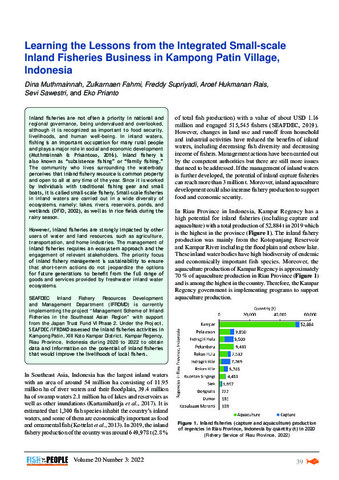
Learning the lessons from the integrated small-scale inland fisheries business in Kampong Patin Village, Indonesia
Share
trừu tượng
Inland fisheries are not often a priority in national and regional governance, being undervalued and overlooked, although it is recognized as important to food security, livelihoods, and human well-being. In inland waters, fishing is an important occupation for many rural people and plays a major role in social and economic development (Muthmainnah & Prisantoso, 2016). Inland fishery is also known as “subsistence fishing” or “family fishing.” The community who lives surrounding the waterbody perceives that inland fishery resource is common property and open to all at any time of the year. Since it is worked by individuals with traditional fishing gear and small boats, it is called small-scale fishery. Small-scale fisheries in inland waters are carried out in a wide diversity of ecosystems, namely: lakes, rivers, reservoirs, ponds, and wetlands (DFID, 2002), as well as in rice fields during the rainy season.
However, inland fisheries are strongly impacted by other users of water and land resources, such as agriculture, transportation, and home industries. The management of inland fisheries requires an ecosystem approach and the engagement of relevant stakeholders. The priority focus of inland fishery management is sustainability to ensure that short-term actions do not jeopardize the options for future generations to benefit from the full range of goods and services provided by freshwater inland water ecosystems.
SEAFDEC Inland Fishery Resources Development and Management Department (IFRDMD) is currently implementing the project “Management Scheme of Inland Fisheries in the Southeast Asian Region” with support from the Japan Trust Fund VI Phase 2. Under the Project, SEAFDEC/IFRDMD assessed the inland fisheries activities in Kampong Patin, XIII Koto Kampar District, Kampar Regency, Riau Province, Indonesia during 2020 to 2022 to obtain data and information on the potential of inland fisheries that would improve the livelihoods of local fishers.
Suggested Citation
Muthmainnah, D., Fahmi, Z., Supriyadi, F., Rais, A. H., Sawestri, S., & Prianto, E. (2023). Learning the lessons from the integrated small-scale inland fisheries business in Kampong Patin Village, Indonesia. Fish for the People , 20(3), 39-42. http://hdl.handle.net/20.500.12066/7173
Chủ thể


Bộ sưu tập
Related items
Showing items related by title, author, creator and subject.
-
Fish for the People Vol.20 No.3
(Secretariat, Southeast Asian Fisheries Development Center, 2023-02)Aquatic species are exploited for food security and livelihood but some of them could be fully exploited or overexploited if not properly managed. The ASEAN Member States (AMSs), i.e. Indonesia, Philippines, Thailand, and ... -
Inland fisheries resource enhancement and conservation practices in Myanmar
(Aquaculture Department, Southeast Asian Fisheries Development Center, 2015)Myanmar has impressive freshwater capture fisheries. Inland freshwater bodies cover 8.1 million ha of which 1.3 million ha are permanent while the rest are seasonally inundated floodplains. There are repeated references ... -
The features of inland fisheries in Southeast Asia
(Inland Fishery Resources Development and Management Department, Southeast Asian Fisheries Development Center, 2019)Numerous bodies of inland waters are widely spread in Southeast Asia where fisheries production is an important source of people's animal protein. The capture fisheries sector, utilizing the inland waters, provides employment ...