Policies of Indonesia for sustainable tuna fisheries management: Issues and concerns
ရက်စွဲ
2014Page views
1,124Share
စိတ္တဇ
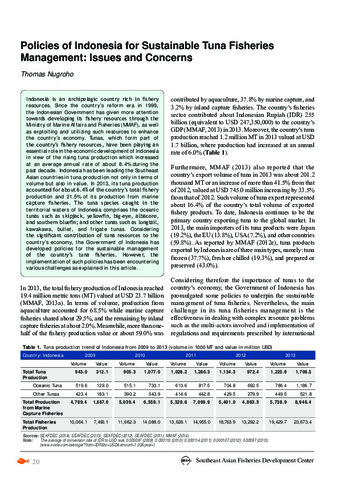
Indonesia is an archipelagic country rich in fishery resources. Since the country's reform era in 1999, the Indonesian Government has given more attention towards developing its fishery resources through the Ministry of Marine Affairs and Fisheries (MMAF), as well as exploiting and utilizing such resources to enhance the country's economy. Tunas, which form part of the country's fishery resources, have been playing an essential role in the economic development of Indonesia in view of the rising tuna production which increased at an average annual rate of about 8.4% during the past decade. Indonesia has been leading the Southeast Asian countries in tuna production not only in terms of volume but also in value. In 2013, its tuna production accounted for about 6.4% of the country's total fishery production and 21.5% of its production from marine capture fisheries. The tuna species caught in the territorial waters of Indonesia comprises the oceanic tunas such as skipjack, yellowfin, big-eye, albacore, and southern bluefin; and other tunas such as longtail, kawakawa, bullet, and frigate tunas. Considering the significant contribution of tuna resources to the country's economy, the Government of Indonesia has developed policies for the sustainable management of the country's tuna fisheries. However, the implementation of such policies has been encountering various challenges as explained in this article.
Suggested Citation
Nugroho, T. (2014). Policies of Indonesia for sustainable tuna fisheries management: Issues and concerns. Fish for the People , 12(3), 20-24. http://hdl.handle.net/20.500.12066/948
ဘာသာရပ်

စုစည်းမှုများ စုစည်းမှုများ
Related items
Showing items related by title, author, creator and subject.
-
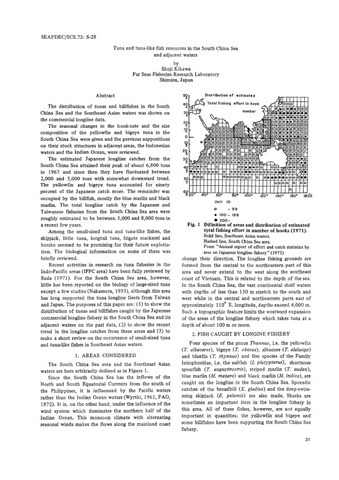
Tuna and tuna-like fish resources in the South China Sea and adjacent waters
(Japan International Cooperation Agency, 1977)The distribution of tunas and billfishes in the South China Sea and the Southeast Asian waters was shown on the commercial longline data. The seasonal changes in the hook-rate and the size composition of the yellowfin and ... -
Regional survey of heavy metals in fish and fish products: Thailand
(Marine Fisheries Research Department, Southeast Asian Fisheries Development Center, 2008)The study was conducted to determine the level of heavy metals such as cadmium, lead and total mercury in fish and fish products in Thailand. The following are the fish products that were evaluated in the study, frozen ... -
Tuna resource exploration with tuna longline in the South China Sea, Area IV: Vietnamese waters
(Secretariat, Southeast Asian Fisheries Development Center, 2001)The survey was designed to be carried out only in the central part of the whole area which was considered as deep sea or oceanic zone. Depth of water is mostly more than 1,000 m deep. The exploration area was covered from ...