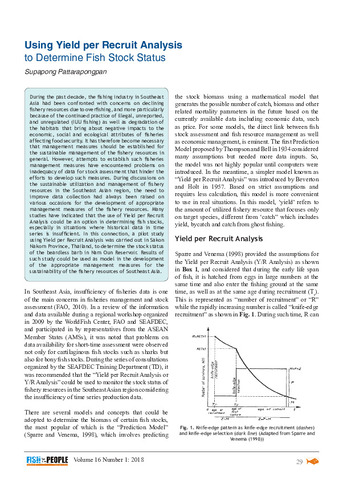
Using yield per recruit analysis to determine fish stock status
Share
trừu tượng
During the past decade, the fishing industry in Southeast Asia had been confronted with concerns on declining fishery resources due to overfishing, and more particularly because of the continued practice of illegal, unreported, and unregulated (IUU fishing) as well as degradation of the habitats that bring about negative impacts to the economic, social and ecological attributes of fisheries affecting food security. It has therefore become necessary that management measures should be established for the sustainable management of the fishery resources in general. However, attempts to establish such fisheries management measures have encountered problems on inadequacy of data for stock assessment that hinder the efforts to develop such measures. During discussions on the sustainable utilization and management of fishery resources in the Southeast Asian region, the need to improve data collection had always been raised on various occasions for the development of appropriate management measures of the fishery resources. Many studies have indicated that the use of Yield per Recruit Analysis could be an option in determining fish stocks, especially in situations where historical data in time series is insufficient. In this connection, a pilot study using Yield per Recruit Analysis was carried out in Sakon Nakorn Province, Thailand, to determine the stock status of the beardless barb in Nam Oun Reservoir. Results of such study could be used as model in the development of the appropriate management measures for the sustainability of the fishery resources of Southeast Asia.
Suggested Citation
Pattarapongpan, S. (2018). Using yield per recruit analysis to determine fish stock status. Fish for the People , 16(1), 29-34. http://hdl.handle.net/20.500.12066/1360
Chủ thể

Bộ sưu tập
Related items
Showing items related by title, author, creator and subject.
-
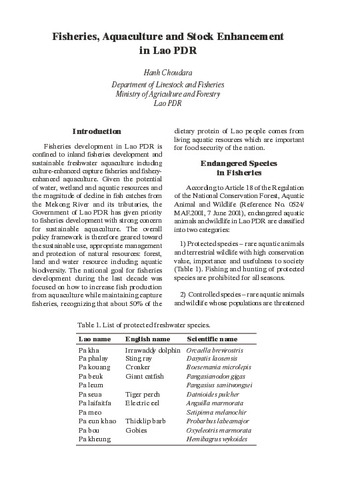
Fisheries, aquaculture and stock enhancement in Lao PDR
(Aquaculture Department, Southeast Asian Fisheries Development Center, 2006)Fisheries development in Lao PDR is confined to inland fisheries development and sustainable freshwater aquaculture including culture-enhanced capture fisheries and fishery-enhanced aquaculture. Given the potential of ... -
Current Status of Fish Stock Enhancement in Thailand
(Training Department, Southeast Asian Fisheries Development Center, 2016)Aquatic animals from natural waters have long been exploited by rural poor as cheap protein food. Natural waters including rivers, canals, swamps, lakes, large reservoirs, and small water bodies are significantly exploited ... -
Status of Fishing Conditions in Japan in Relation to Responsible Fisheries
(Training Department, Southeast Asian Fisheries Development Center, 1997)The presence of a large number of species that are low in quantity in Japan's coastal waters has resulted in the evolution of a food culture that has historically utilized most of the catch species and sizes that are caught ...