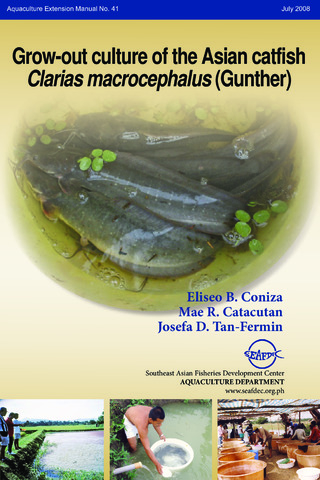
Grow-out culture of the Asian catfish Clarias macrocephalus (Gunther)
Share
นามธรรม
Asian catfish Clarias macrocephalus is an esteemed food fish especially in Southeast Asia due to its tender and delicious meat. This commodity constitutes a valuable fishery for small-scale fishers in the region and has a great potential for aquaculture. The important considerations in the grow-out culture of catfish are reliable water supply, soil with good compaction properties for dike construction, supply of fingerlings, feeds, labor, pond supplies and technology assistance. The farm must also be accessible by road, near to market facilities and has a peaceful environment. Rearing catfish in ponds is the most popular and commonly practiced. The pen culture is a system fully enclosed by nets on all sides but utilizes the dug-out pond, dam or lake bed as bottom enclosure. Tanks in abandoned old hatcheries with freshwater source can be used for catfish culture. In the cage culture system the stock is fully enclosed by nylon nets on all sides and bottom similar to an inverted mosquito net installed in suitable areas like reservoirs, dams, lakes and dug-out ponds. The rice-fish (catfish) culture is also practiced where the rice pond canals are utilized to retain water at 1-2 m depth to provide shelter to the fish while the rice plot maintains 10-20 cm water depth. For the stock, select fingerlings that are active, healthy and uniform in size. Handling of fish stock is important to avoid mortality due to stress during harvest, sorting, counting and transport. Furthermore, stocking of fish is recommended during the cooler part of the day. Catfish fingerlings stocking density is about 5 to 20 pcs/m2 depending on the water supply and support facilities of the farm. The catfish, C. macrocephalus, requires a substantial amount of dietary protein for growth. For this species a formulated diet with crude protein (CP) of 34%, moist diet (trash fish or blanched chicken entrails plus rice bran or cooked broken rice), and a combination of pellet feeds (50%) and moist diet (50%) have been tested and acceptable for the grow-out culture. Economic evaluation based on a grow-out culture in pond with an area of 1,000 m2 showed that feeds and fingerlings are the major variable costs. The net income, return on investments and payback period, respectively range from PhP22,972-PhP35,741, 80-122% and 0.8-1.2 years when using pellet, moist feed or a combination of these feeds. Feeding using formulated diet has an advantage of convenience, quality and quantity over moist diet which has issues such as inconsistent supply, storage requirement and fouling the rearing water.
การอ้างอิง
Coniza, E. B., Catacutan, M. R., & Tan-Fermin, J. D. (2008). Grow-out culture of the Asian catfish Clarias macrocephalus (Gunther). Tigbauan, Iloilo, Philippines: SEAFDEC Aquaculture Department.
เรื่อง

คอลเลกชัน
รายการที่เกี่ยวข้อง
แสดงรายการที่เกี่ยวข้องตามชื่อผู้แต่งผู้สร้างและเรื่อง
-
Management of feeding aquaculture species
(Aquaculture Department, Southeast Asian Fisheries Development Center, 2002)This chapter teaches the reader to: differentiate the different feeding strategies in pond culture; learn feeding management methods such as stock sampling and record keeping, calculating daily feed ration, choosing ... -
Aquaculture development in Thailand
(Aquaculture Department, Southeast Asian Fisheries Development Center, 1988)Aquaculture practised in Thailand is in the form of pond culture and cage culture in freshwater, brackishwater and coastal areas. The main species cultured include freshwater prawns, brackishwater shrimp, cockles, mussels, ... -
Fish nutrition
(Aquaculture Department, Southeast Asian Fisheries Development Center, 1989)