01 SEAFDEC Publications: Recent submissions
Now showing items 3301-3320 of 3902
-
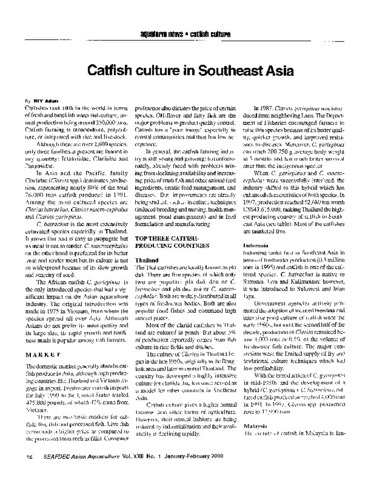
Catfish culture in Southeast Asia
(Aquaculture Department, Southeast Asian Fisheries Development Center, 2000)Catfish rank fifth in the world in terms of fresh and brackishwater fish culture. In Asia and the Pacific, the Clariidae family dominates production, representing nearly 80% of the total catfish production. Among the most ... -
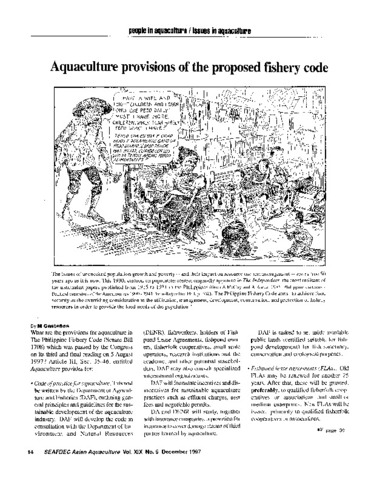
Aquaculture provisions of the proposed fishery code
(Aquaculture Department, Southeast Asian Fisheries Development Center, 1997)A list is given of the provisions for aquaculture in the Philippine Fishery Code, passed by Congress on its third and final reading on 5 August 1997, under the following headings: 1) Code of practice for aquaculture; 2) ... -
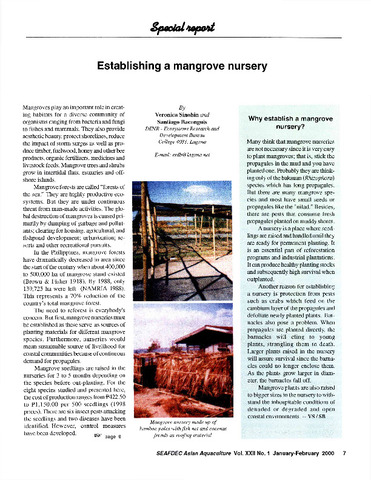
Establishing a mangrove nursery
(Aquaculture Department, Southeast Asian Fisheries Development Center, 2000)Mangroves play an important role in creating habitats for a diverse community of organisms ranging from bacteria and fungi to fishes and mammals. They grow in intertidal flats, estuaries and offshore islands. In the ... -
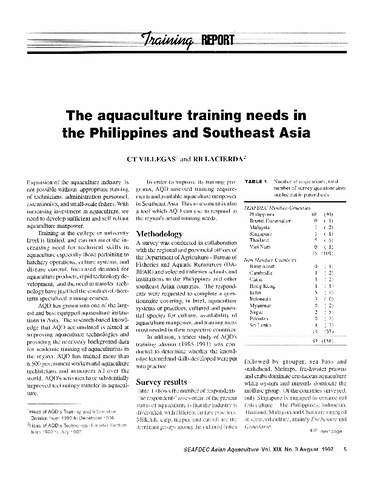
The aquaculture training needs in the Philippines and Southeast Asia
(Aquaculture Department, Southeast Asian Fisheries Development Center, 1997)AQD has grown into one of the largest and best equipped aquaculture institutions in Asia. The research-based knowledge that AQD has accumulated is aimed at improving aquaculture technologies and providing the necessary ... -
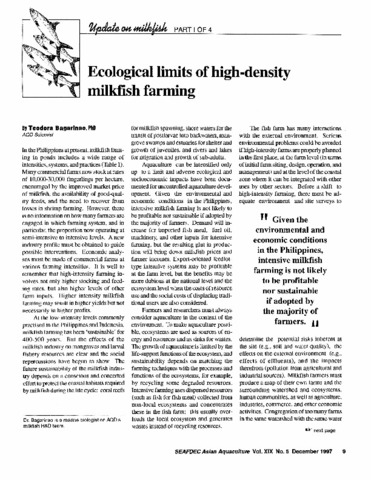
Ecological limits of high-density milkfish farming
(Aquaculture Department, Southeast Asian Fisheries Development Center, 1997)In the Philippines at present, milkfish farming in ponds includes a wide range of intensities, systems and practices. To make aquaculture possible, ecosystems are used as sources of energy and resources and as sinks for ... -
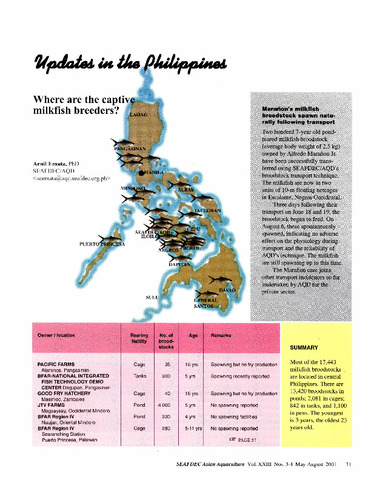
Updates in the Philippines: Where are the captive milkfish breeders?
(Aquaculture Department, Southeast Asian Fisheries Development Center, 2001)A map is provided showing the location of milkfish rearing facilities in the Philippines. Most of the 17,443 milkfish broodstocks are located in central Philippines. A table shows details as to the rearing facility (cage, ... -
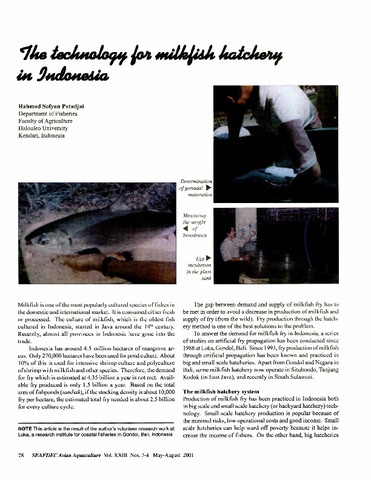
The technology for milkfish hatchery in Indonesia
(Aquaculture Department, Southeast Asian Fisheries Development Center, 2001)The culture of milkfish (Chanos chanos), which is the oldest fish cultured in Indonesia, has spread to almost all the provinces in the country. In order to answer the demand of milkfish fry, without decreasing production ... -
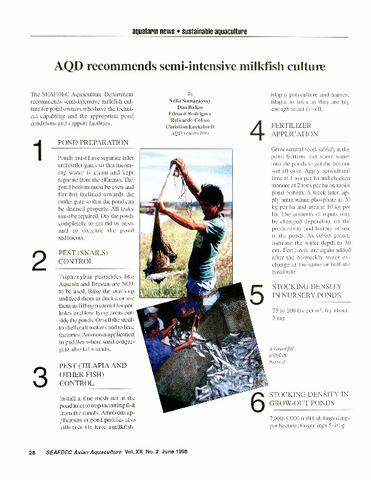
AQD recommends semi-intensive milkfish culture
(Aquaculture Department, Southeast Asian Fisheries Development Center, 1998)Details are given of a system for semi-intensive milkfish (Chanos chanos) vulture recommended by the SEAFDEC Aquaculture Department, under the following headings: 1) Pond preparation; 2) Pest (snails) control; 3) Pest ... -
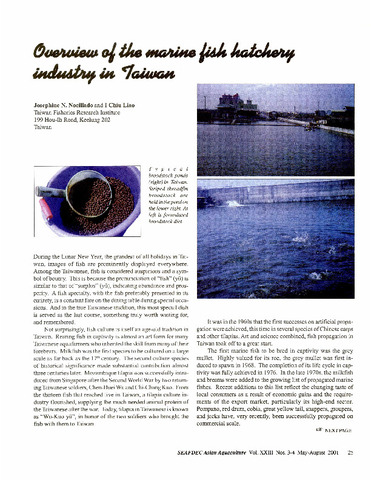
Overview of the marine fish hatchery industry in Taiwan
(Aquaculture Department, Southeast Asian Fisheries Development Center, 2001)Although fish culture itself is an age-old tradition in Taiwan, it was in the 1960s that the first successes on artificial propagation were achieved, with several species of Chinese carps and tilapias. The first marine ... -
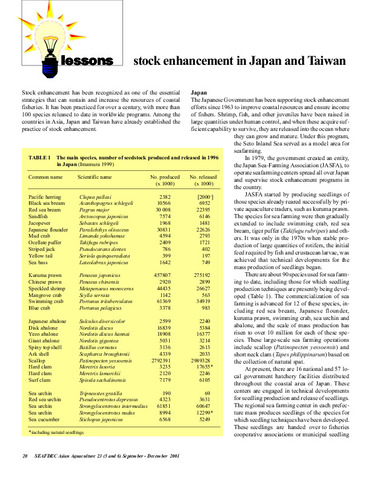
Stock enhancement in Japan and Taiwan
(Aquaculture Department, Southeast Asian Fisheries Development Center, 2001)Stock enhancement has been recognized as one of the essential strategies that can sustain and increase the resources of coastal fisheries. It has been practiced for over a century, with more than 100 species released to ... -
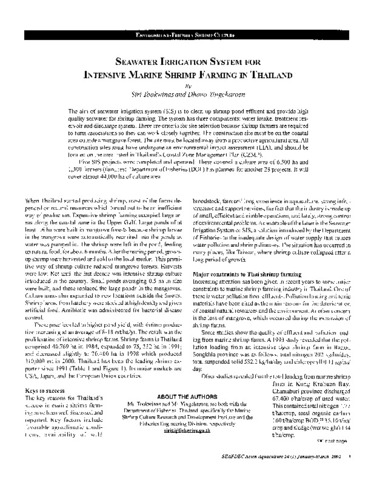
Seawater irrigation system for intensive marine shrimp farming in Thailand
(Aquaculture Department, Southeast Asian Fisheries Development Center, 2002)The aim of the seawater irrigation system (SIS) is to clean up shrimp pond effluent and provide high quality seawater for shrimp farming. The system has 3 components: water intake; treatment reservoir and discharge system. ... -
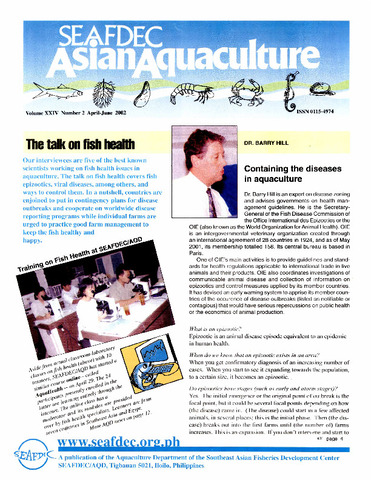
Containing the diseases in aquaculture
(Aquaculture Department, Southeast Asian Fisheries Development Center, 2002)A brief discussion is presented on epizootics and their containment in the aquaculture industry, in the form of a question-and-answer interview. Particular reference is made to activities carried out by the OIE (Office ... -
Detection of pesticide residues in aquaculture products
(Aquaculture Department, Southeast Asian Fisheries Development Center, 2004)Agricultural chemicals such as fertilizers and pesticides have made an important contribution to agriculture. Pesticides protect crops from pests and diseases. They have brought about large yield increases, and have helped ... -
Detection of antibiotic residues in aquaculture products
(Aquaculture Department, Southeast Asian Fisheries Development Center, 2004)Aquacultured animals are under constant threat from bio-aggressors such as viruses, bacteria, parasites and fungi. These organisms harm either spontaneously or through aquatic animal husbandry practices, and often both. ... -
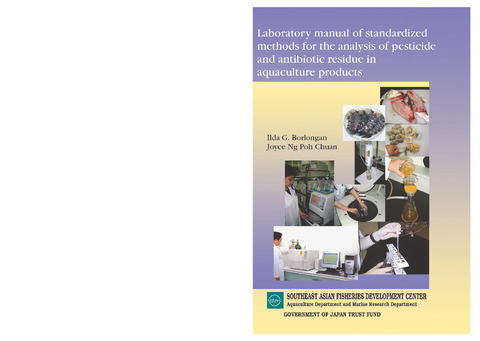
Laboratory manual of standardized methods for the analysis of pesticide and antibiotic residue in aquaculture products
(Aquaculture Department, Southeast Asian Fisheries Development Center, 2004)The manual contains guidelines on the detection of antibiotic and pesticide residues in aquaculture products. Different methods for the analysis of the two chemicals are discussed. The manual is expected to benefit all ... -
Current status of transboundary fish diseases in Vietnam: Occurrence, surveillance, research and training
(Aquaculture Department, Southeast Asian Fisheries Development Center, 2004)The paper discussed the current status of transboundary fish diseases in Vietnam. The following were given focus in the paper: status of Koi Herpesvirus in the production of common carp and koi and the status of viral ... -
Current status of transboundary fish diseases in Thailand: Occurrence, surveillance, research and training
(Aquaculture Department, Southeast Asian Fisheries Development Center, 2004)The paper discussed the current status of transboundary fish diseases in Thailand. The following were given focus in the paper: status of Koi Herpesvirus in the production of common carp and koi and the status of viral ... -
Current status of transboundary fish diseases in Singapore: Occurrence, surveillance, research and training
(Aquaculture Department, Southeast Asian Fisheries Development Center, 2004)The paper discussed the current status of transboundary fish diseases in Singapore. The following were given focus in the paper: status of Koi Herpesvirus in the production of common carp and koi and the status of viral ... -
Current status of transboundary fish diseases in the Philippines: Occurrence, surveillance, research and training
(Aquaculture Department, Southeast Asian Fisheries Development Center, 2004)The paper discussed the current status of transboundary fish diseases in Philippines. The following were given focus in the paper: status of Koi Herpesvirus in the production of common carp and koi and the status of viral ... -
Current status of transboundary fish diseases in Myanmar: Occurrence, surveillance, research and training
(Aquaculture Department, Southeast Asian Fisheries Development Center, 2004)The paper discussed the current status of transboundary fish diseases in Myanmar. The following were given focus in the paper: status of Koi Herpesvirus in the production of common carp and koi and the status of viral ...