01 SEAFDEC Publications: Recent submissions
Ipinapakita ngayon ang mga item 2501-2520 ng 3916
-
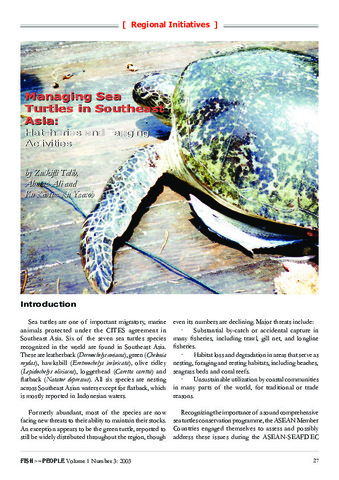
Managing sea turtles in Southeast Asia: Hatcheries and tagging activities
(Secretariat, Southeast Asian Fisheries Development Center, 2003)This article aims to highlight the status of sea turtles hatcheries and tagging activities in eight ASEAN-SEAFDEC member countries, namely Brunei Darussalam, Cambodia, Indonesia, Malaysia, Myanmar, Philippines, Thailand ... -
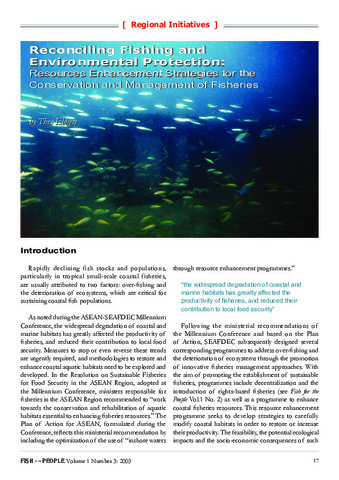
Reconciling fishing and environmental protection: Resources enhancement strategies for the conservation and management of fisheries
(Secretariat, Southeast Asian Fisheries Development Center, 2003)The article is a reflection of the discussion and the results of a regional workshop conducted by the SEAFDEC (Southeast Asian Fisheries Development Center) Training Department in which the methodologies and techniques for ... -
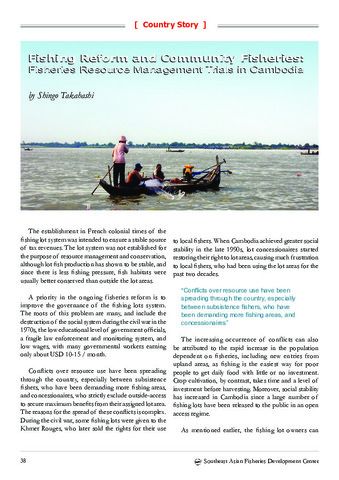
Fishing reform and community fisheries: Fisheries resource management trials in Cambodia
(Secretariat, Southeast Asian Fisheries Development Center, 2003)The initiative of Cambodia to promote community fisheries in order to improve the resource management is presented. This initiative is part of a decentralization policy that aims to encourage the appropriate transfer of ... -
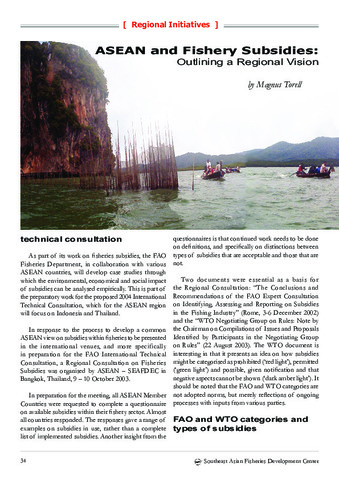
ASEAN and fishery subsidies: Outlining a regional vision
(Secretariat, Southeast Asian Fisheries Development Center, 2003)This paper summarizes the outputs of the Regional Consultation on Fisheries Subsidies organized by ASEAN-SEAFDEC in Bangkok, Thailand 9-10 October 2003. In preparation for the meeting all ASEAN member countries were requested ... -
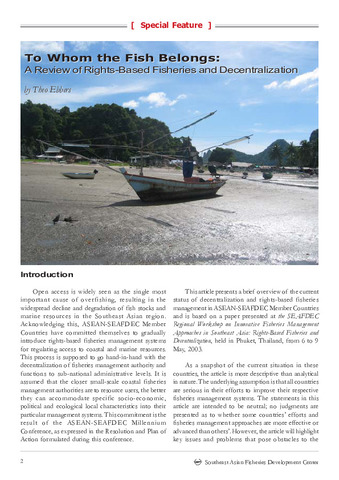
To whom the fish belongs: A review of rights-based fisheries and decentralization
(Secretariat, Southeast Asian Fisheries Development Center, 2003)This article presents a brief overview of the current status of decentralization and rights-based fisheries management in ASEAN-SEAFDEC (Southeast Asian Fisheries Development Center) Member Countries and is based on a paper ... -
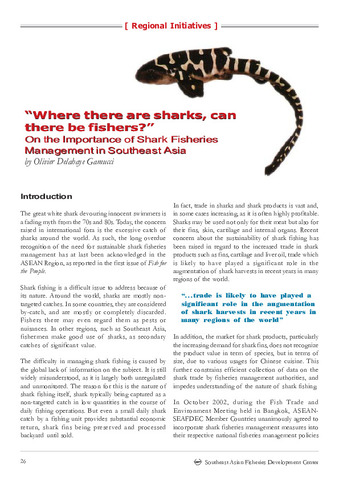
"Where there are sharks, can there be fishers?" On the importance of shark fisheries management in Southeast Asia
(Secretariat, Southeast Asian Fisheries Development Center, 2003)An overview on the importance of shark fisheries management in Southeast Asia is given. In particular recent progress in the region, status and trends of shark fisheries, utilization and trade of shark are given. -
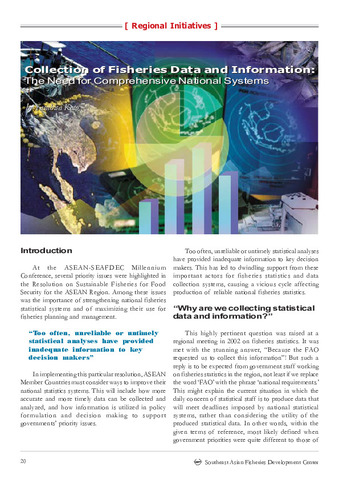
Collection of fisheries data and information: The need for comprehensive national systems
(Secretariat, Southeast Asian Fisheries Development Center, 2003) -
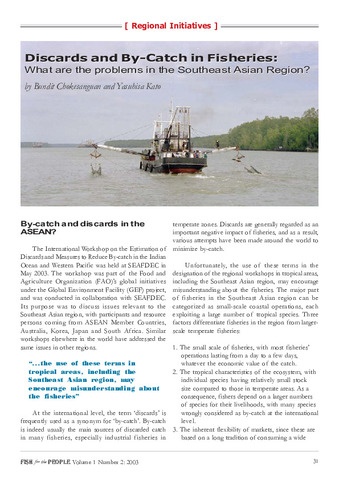
Discards and by-catch in fisheries: What are the problems in the Southeast Asian region?
(Secretariat, Southeast Asian Fisheries Development Center, 2003)This paper summarizes the decisions and the outputs of the International Workshop on the Estimation of Discards and Measures to Reduce By-Catch in the Indian Ocean and Western Pacific held in May 2003 focusing in particular ... -
Proceedings of the International Seminar-Workshop on Mud Crab Aquaculture and Fisheries Management, 10-12 April 2013, Tamil Nadu, India
(Rajiv Gandhi Centre for Aquaculture (MPEDA), 2015) -
Development of practical diet for the grow-out culture of Scylla serrata in ponds
(Rajiv Gandhi Centre for Aquaculture (MPEDA), 2015)A series of feeding experiments were conducted in the laboratory and in ponds of SEAFDEC/AQD using hatchery-produced Scylla serrata juveniles to develop an effective pelleted grow-out diet. The practical feed ingredients ... -
Soft-shell crab production using hatchery-produced mangrove crab Scylla serrata juveniles
(Rajiv Gandhi Centre for Aquaculture (MPEDA), 2015)Soft-shell crab production is being practiced in many Asian countries but the major source of seedstock is from the wild, which could no longer sustain the increasing demand. Commercial scale soft-shell crab production can ... -
Culture of Scylla serrata (Forskal) in cement ponds
(Rajiv Gandhi Centre for Aquaculture (MPEDA), 2015)Male and female Scylla serrata juvenile crabs were stocked separately in cement ponds (14 x 8 x 0.8 m; 90 m3) and reared for 90 days. The study was conducted at the Fisheries Research Station, JAU. Okha, Gujarat. The crabs ... -
Mud crab nursery rearing practices
(Rajiv Gandhi Centre for Aquaculture (MPEDA), 2015)The need for seeds for expansion of the mud crab industry led to the development of the hatchery technology. The nursery technology was developed as this served as a link between the hatchery, which produces megalopae or ... -
Effect of tank color on the survival of mud crab Scylla serrata larvae
(Rajiv Gandhi Centre for Aquaculture (MPEDA), 2015)The survival rate of mud crab or mangrove crab Scylla serrata larvae was evaluated using black and yellow-painted tanks. About 400,000 zoea 1 were stocked in 6 tons of treated seawater. The larvae were initially fed with ... -
Mass seed production of mud crab Scylla serrata at Rajiv Gandhi Centre for Aquaculture
(Rajiv Gandhi Centre for Aquaculture (MPEDA), 2015)Mass seed production of mud crab Scylla serrata adopting the best management practices has been done in the hatchery of Rajiv Gandhi Centre for Aquaculture, Thoduvai in Tamil Nadu. Mature female mud crabs from farms and ... -
Reproductive biology of mud crab Scylla tranquebarica found in Ratnagiri coast, Maharashtra, India
(Rajiv Gandhi Centre for Aquaculture (MPEDA), 2015)The study was carried out to determine the reproductive biology of the mud crab Scylla tranquebarica to provide baseline information that are useful in the seed production activities. Size at first maturation was observed ... -
Scylla species found in Cochin backwaters, Kerala, South India
(Rajiv Gandhi Centre for Aquaculture (MPEDA), 2015)The present study described the Scylla species collected from Cochin backwaters for two years from June 2010 to May 2012. Identification and description of Scylla species were carried out based on the morphological characters ... -
Molecular genetic approaches to resolve taxonomical ambiguity of mud crab species (Genus Scylla) in Indian waters
(Rajiv Gandhi Centre for Aquaculture (MPEDA), 2015)Mud crab or mangrove crab (Genus Scylla de Haan) is one of the most extensively cultured and economically important brachyuran crabs from the family Portunidae in Indo-Pacific countries, including India. Mud crabs exhibit ... -
Status of mud crab industry in Thailand
(Rajiv Gandhi Centre for Aquaculture (MPEDA), 2015)Mud crab is an economically important crustacean commodity in Thailand due to its high nutritional and market value. All the four species of mud crab, Scylla paramamosain, S. olivacea, S. serrata and S. tranquebarica are ... -
Status of mud crab industry in India
(Rajiv Gandhi Centre for Aquaculture (MPEDA), 2015)Mud crab is an economically important portunid crab species found in estuaries, coastal lagoons and nearshore waters of India. The genetics team of RGCA recently made an attempt to decipher the taxonomic ambiguity of mud ...