Artificial fertilization of eggs and early development of the milkfish Chanos chanos (Forskal)
Share
ບົດຄັດຫຍໍ້
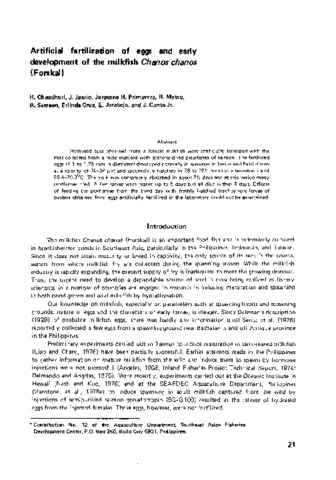
Hydrated eggs obtained from a female milkfish were artificially fertilized with the milt collected from a male injected with acetone-dried pituitaries of salmon. The fertilized eggs (1.1 to 1.25 mm in diameter) developed normally in seawater in basins and Petri dishes at a salinity of 30-34 ppt and successfully hatched in 25 to 28½ hours at a temperature of 26.4-29.9°C. The yolk was completely absorbed in about 2½ days and at this period many postlarvae died. A few larvae were reared up to 5 days but all died within 6 days. Effects of feeding the postlarvae from the third day with freshly hatched trochophore larvae of oysters obtained from eggs artificially fertilized in the laboratory could not be ascertained.
ລາຍລະອຽດ
Contribution No. 12 of the Aquaculture Department, Southeast Asian Fisheries Development Center, P.O. Box 256, Iloilo City 5901, Philippines.
Suggested Citation
Chaudhuri, H., Juario, J. V., Primavera, J. H., Mateo, R., Samson, R., Cruz, E., … Canto, J. J. (1977). Artificial fertilization of eggs and early development of the milkfish Chanos chanos (Forskal). In: Induced spawning, artificial fertilization of eggs and larval rearing of the milkfish Chanos chanos (Forskal) in the Philippines (Technical Report No. 3) (pp. 21-38). Tigbauan, Iloilo, Philippines: Aquaculture Department, Southeast Asian Fisheries Development Center.
ວິຊາ

Taxonomic term

Collections
Related items
Showing items related by title, author, creator and subject.
-
Small-scale freshwater aquaculture development: Experiences from the Philippines on giant freshwater prawn, milkfish and tilapia
(Japan International Cooperation Agency, 2013-12)The Aquaculture Department of the Southeast Asian Fisheries Development Center (SEAFDEC/AQD) has been promoting a number of programs towards effective dissemination and adoption of science-based aquaculture technologies ... -
Economic value of the milkfish industry
(Aquaculture Department, Southeast Asian Fisheries Development Center, 1998)A brief description is given of the milkfish (Chanos chanos) farming industry in the Philippines. Over the past 20 years, the relative importance of milkfish has declined with the expansion of tilapia, tiger shrimp and ... -
Milkfish ponds from mangroves
(Aquaculture Department, Southeast Asian Fisheries Development Center, 1998)