Small-scale freshwater aquaculture development: Experiences from the Philippines on giant freshwater prawn, milkfish and tilapia
Share
trừu tượng
The Aquaculture Department of the Southeast Asian Fisheries Development Center (SEAFDEC/AQD) has been promoting a number of programs towards effective dissemination and adoption of science-based aquaculture technologies for rural aquaculture development. This is in line with the national government development program on sustainable aquaculture, which is implemented in agreement with the country’s Fisheries Code of 1998 and Local Government Code of 1991.
SEAFDEC AQD, through its Binangonan Freshwater Station (BFS), offers extension services and training courses on freshwater aquaculture. Also, AQD has been providing technical support to other countries through a series of regional trainings on freshwater aquaculture to facilitate the dissemination of aquaculture technologies and to capacitate the various stakeholders on this aspect. Aside from training activities, AQD established the Agree-Build-Operate-Transfer (ABOT) AquaNegosyo program which caters to private investors. In this program, AQD assists fish farmers from site selection, design and construction of facilities and monitoring of production run until harvest. Another program is called the Institutional Capacity Development for Sustainable Aquaculture (ICDSA) which aims to establish partnerships and build the capacities of local government units (LGUs), community-based organization and non-government organizations (NGOs), fishery schools and other local institutions. This is through training and information dissemination, on-farm demonstration and on-site consultations on fish culture.
AQD continues to carry out research and development (R&D) activities on various commodities and disciplines. One of the R&D programs developed by AQD is the “Meeting Social and Economic Challenges in Aquaculture Program” or MSECAP. This program aims to develop and implement social and economic strategies in aquaculture and resource management for food security and poverty alleviation in rural communities (Salayo et al. 2012). The five-year targets (2012-2016) of the MSECAP are directed on the implementation of R&D activities which include the (1) promotion of aquaculture technologies in inland and coastal communities through verification and on-site demonstration activities and (2) the development of appropriate technology adoption pathways for aquaculture technologies, among others (Salayo et al., 2012).
Suggested Citation
Aya, F. (2013). Small-scale freshwater aquaculture development: Experiences from the Philippines on giant freshwater prawn, milkfish and tilapia. In Proceedings of the International Symposium on Small-scale Freshwater Aquaculture Extension (pp. 8–13). Tokyo, Japan: Japan International Cooperation Agency; Bangkok, Thailand: Network of Aquaculture Centres in Asia-Pacific; Bangkok, Thailand: Royal Thai Department of Fisheries.
Chủ thể

Taxonomic term

Bộ sưu tập
Related items
Showing items related by title, author, creator and subject.
-
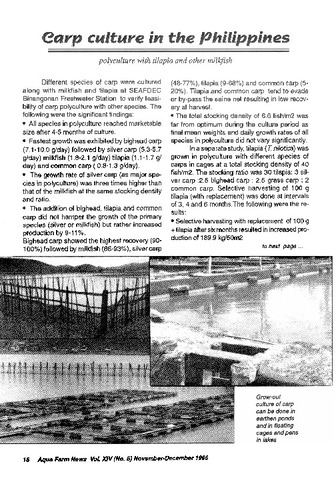
Carp culture in the Philippines: polyculture with tilapia and other milkfish
(Aquaculture Department, Southeast Asian Fisheries Development Center, 1996)The paper presents the result of the study on the polyculture of the different species of carp with tilapia and milkfish. Polyculture does not hamper the growth of primary species but rather increased the production. ... -
Assessment of tilapia-freshwater prawn co-culture schemes in tanks and lake-based cages for increased farm production
(MDPI, 2021-12-08)The technical viability of tilapia (I-ExCEL strain Nile or red) and giant freshwater prawn (GFP) co-culture in cages-within-tanks was evaluated while appropriate feeding protocols for tilapia-GFP co-culture in cages in a ... -
Evaluation of milkfish (Chanos chanos Forskal) and prawn (Penaeus monodon Fabricus) in polyculture system
(Fisheries Research Society of the Philippines, 1982)The growth, survival and profitability of milkfish (C. chanos ) and prawn (Penaeus monodon ) (averaging 3.1 g and 0.3 g, respectively) grown in five different combinations for 100 days in 500-m super(2) brackishwater ponds ...