
Ecological impacts of seafarming and searanching
Share
Abstract
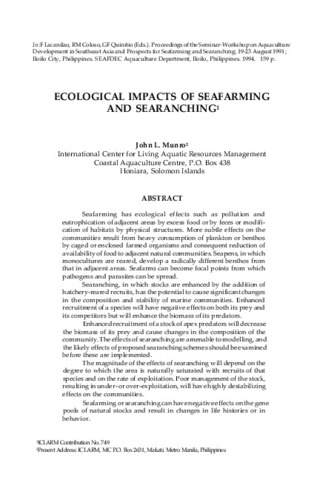
Seafarming has ecological effects such as pollution and eutrophication of adjacent areas by excess food or by feces or modification of habitats by physical structures. More subtle effects on the communities result from heavy consumption of plankton or benthos by caged or enclosed farmed organisms and consequent reduction of availability of food to adjacent natural communities. Seapens, in which monocultures are reared, develop a radically different benthos from that in adjacent areas. Seafarms can become focal points from which pathogens and parasites can be spread.Searanching, in which stocks are enhanced by the addition of hatchery-reared recruits, has the potential to cause significant changes in the composition and stability of marine communities. Enhanced recruitment of a species will have negative effects on both its prey and its competitors but will enhance the biomass of its predators.Enhanced recruitment of a stock of apex predators will decrease the biomass of its prey and cause changes in the composition of the community. The effects of searanching are amenable to modelling, and the likely effects of proposed searanching schemes should be examined before these are implemented.The magnitude of the effects of searanching will depend on the degree to which the area is naturally saturated with recruits of that species and on the rate of exploitation. Poor management of the stock, resulting in under- or over-exploitation, will have highly destabilizing effects on the communities.Seafarming or searanching can have negative effects on the gene pools of natural stocks and result in changes in life histories or in behavior.
Suggested Citation
Munro, J. L. (1994). Ecological impacts of seafarming and searanching. In F. Lacanilao, R. M. Coloso, & G. F. Quinitio (Eds.), Proceedings of the Seminar-Workshop on Aquaculture Development in Southeast Asia and Prospects for Seafarming and Searanching; 19-23 August 1991; Iloilo City, Philippines. (pp. 145-151). Tigbauan, Iloilo, Philippines: Aquaculture Department, Southeast Asian Fisheries Development Center.
Paksa

Mga koleksyon
- ADSEA '91 [21]