Cause of musty flavor in pond-cultured penaeid shrimp
Share
Abstract
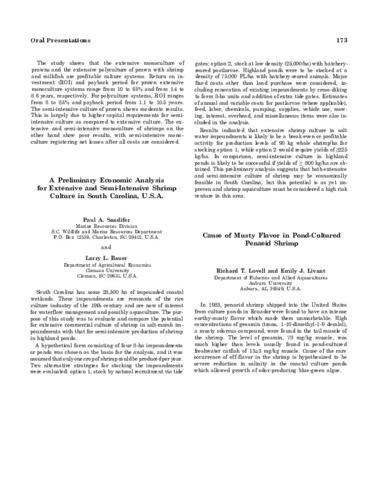
In 1983, penaeid shrimp shipped into the United States from culture ponds in Ecuador were found to have an intense earthy-musty flavor which made them unmarketable. High concentrations of geosmin (trans, 1-10-dimethyl-1-9 decalol), a musty odorous compound, were found in the tail muscle of the shrimp. The level of geosmin, 78 mg/kg muscle, was much higher than levels usually found in pond-cultured freshwater catfish of 13±3 mg/kg muscle. Cause of the rare occurrence of off-flavor in the shrimp is hypothesized to be severe reduction in salinity in the coastal culture ponds which allowed growth of odor-producing blue-green algae.
Description
Abstract only.
Suggested Citation
Lovell, R. T., & Livant, E. J. (1985). Cause of musty flavor in pond-cultured penaeid shrimp (Abstract only). In Taki Y., Primavera J.H. and Llobrera J.A. (Eds.). Proceedings of the First International Conference on the Culture of Penaeid Prawns/Shrimps, 4-7 December 1984, Iloilo City, Philippines (p. 173). Iloilo City, Philippines: Aquaculture Department, Southeast Asian Fisheries Development Center.
Subject
Related items
Showing items related by title, author, creator and subject.
-
Aquaculture in Malaysia
(Aquaculture Department, Southeast Asian Fisheries Development Center, 1995)Aquaculture in Malaysia is experiencing rapid growth. Total production in 1992 amounted to 79,699 tons valued at RM 207.4 million. These figures are 23% and 25% higher than the previous year's. Semi-culture of the cockle ... -
Coastal aquaculture in Thailand
(Aquaculture Department, Southeast Asian Fisheries Development Center, 1995)Coastal aquaculture in Thailand has expanded rapidly in both area and production in the last decade. The important cultured species are the shrimps (Penaeus monodon and P. merguiensis), sea bass Lates calcarifer, groupers ... -
Aquaculture development in Thailand
(Aquaculture Department, Southeast Asian Fisheries Development Center, 1988)Aquaculture practised in Thailand is in the form of pond culture and cage culture in freshwater, brackishwater and coastal areas. The main species cultured include freshwater prawns, brackishwater shrimp, cockles, mussels, ...