Status of mud crab aquaculture in Bangladesh
Share
trừu tượng
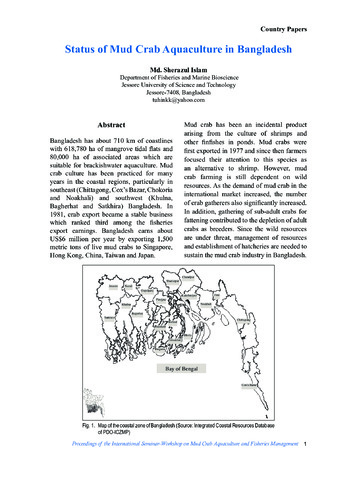
Bangladesh has about 710 km of coastlines with 618,780 ha of mangrove tidal flats and 80,000 ha of associated areas which are suitable for brackishwater aquaculture. Mud crab culture has been practiced for many years in the coastal regions, particularly in southeast (Chittagong, Cox’s Bazar, Chokoria and Noakhali) and southwest (Khulna, Bagherhat and Satkhira) Bangladesh. In 1981, crab export became a stable business which ranked third among the fisheries export earnings. Bangladesh earns about US$6 million per year by exporting 1,500 metric tons of live mud crabs to Singapore, Hong Kong, China, Taiwan and Japan.Mud crab has been an incidental product arising from the culture of shrimps and other finfishes in ponds. Mud crabs were first exported in 1977 and since then farmers focused their attention to this species as an alternative to shrimp. However, mud crab farming is still dependent on wild resources. As the demand of mud crab in the international market increased, the number of crab gatherers also significantly increased. In addition, gathering of sub-adult crabs for fattening contributed to the depletion of adult crabs as breeders. Since the wild resources are under threat, management of resources and establishment of hatcheries are needed to sustain the mud crab industry in Bangladesh.
Suggested Citation
Islam, M. S. (2015). Status of mud crab aquaculture in Bangladesh. In E. T. Quinitio, F. D. Parado-Estepa, Y. C. Thampi Sam Raj, & A. Mandal (Eds.), Proceedings of the International Seminar-Workshop on Mud Crab Aquaculture and Fisheries Management, 10-12 April 2013, Tamil Nadu, India (pp. 1-6). Tamil Nadu, India: Rajiv Gandhi Centre for Aquaculture (MPEDA).
Chủ thể

Related items
Showing items related by title, author, creator and subject.
-
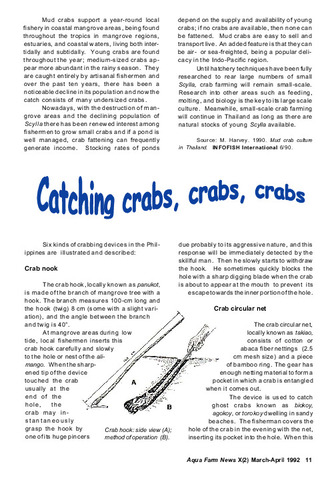
Catching crabs, crabs, crabs
(Aquaculture Department, Southeast Asian Fisheries Development Center, 1992) -
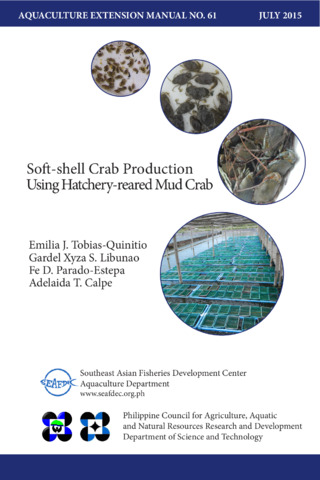
Soft-shell crab production using hatchery-reared mud crab
(Aquaculture Department, Southeast Asian Fisheries Development Center; Philippine Council for Agriculture, Aquatic and Natural Resources Research and Development (PCAARRD), 2015)"The production of soft-shell crabs is well established in other Asian countries but its sustainability is already being threatened due to the decreasing mud crab population in the wild where the seedstocks are sourced. ... -
Monosex culture of the mud crab Scylla serrata at three stocking densities with Gracilaria as crab shelter
(Australian Centre for International Agricultural Research, 1999)The effects of three levels of stocking density (0.5, 1.5 or 3.0/m2) and monosex culture (male or female) on the growth, survival and production of Scylla serrata were investigated. Juvenile crabs were stocked in 150 m2 ...