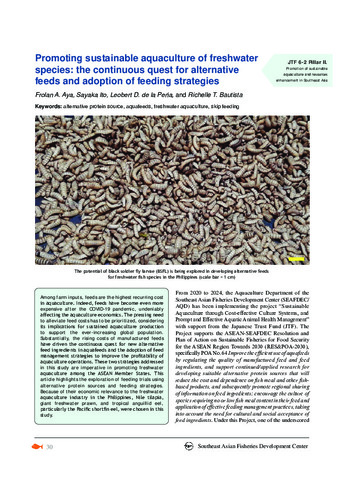
Promoting sustainable aquaculture of freshwater species: The continuous quest for alternative feeds and adoption of feeding strategies
Share
นามธรรม
Among farm inputs, feeds are the highest recurring cost in aquaculture. Indeed, feeds have become even more expensive after the COVID-19 pandemic, undeniably affecting the aquaculture economics. The pressing need to alleviate feed costs has to be prioritized, considering its implications for sustained aquaculture production to support the ever-increasing global population. Substantially, the rising costs of manufactured feeds have driven the continuous quest for new alternative feed ingredients in aquafeeds and the adoption of feed management strategies to improve the profitability of aquaculture operations. These two strategies addressed in this study are imperative in promoting freshwater aquaculture among the ASEAN Member States. This article highlights the exploration of feeding trials using alternative protein sources and feeding strategies. Because of their economic relevance to the freshwater aquaculture industry in the Philippines, Nile tilapia, giant freshwater prawn, and tropical anguillid eel, particularly the Pacific shortfin eel, were chosen in this study.
การอ้างอิง
Aya, F. A., Ito, S., de la Peńa, L. D., & Bautista, R. T. (2024). Promoting sustainable aquaculture of freshwater species: The continuous quest for alternative feeds and adoption of feeding strategies. Fish for the People , 22(2), 30-34. http://hdl.handle.net/20.500.12066/7520
เรื่อง

คอลเลกชัน
รายการที่เกี่ยวข้อง
แสดงรายการที่เกี่ยวข้องตามชื่อผู้แต่งผู้สร้างและเรื่อง
-
Aquaculture development in Thailand
(Aquaculture Department, Southeast Asian Fisheries Development Center, 1988)Aquaculture practised in Thailand is in the form of pond culture and cage culture in freshwater, brackishwater and coastal areas. The main species cultured include freshwater prawns, brackishwater shrimp, cockles, mussels, ... -
Growth and yield of Asian catfish Clarias macrocephalus (Gunther) fed different grow-out diets
(Aquaculture Department, Southeast Asian Fisheries Development Center, 2003) -
Aquaculture development in Malaysia
(Aquaculture Department, Southeast Asian Fisheries Development Center, 1988)Malaysia is a fish-consuming country with fish representing 60% of a total animal protein intake. At an annual per capita consumption of 32 kg some 560 000 mt of fish is required for the projected of 17.5 million people ...