Empowering Small-scale Fishers through Community Fish Landing Centers in the Philippines
Share
| dc.contributor.author | Juan, Beverly S. San | |
| dc.date.accessioned | 2026-01-05T02:52:25Z | |
| dc.date.available | 2026-01-05T02:52:25Z | |
| dc.date.issued | 2025-12 | |
| dc.identifier.uri | http://hdl.handle.net/20.500.12066/7645 | |
| dc.description.abstract | The Bureau of Fisheries and Aquatic Resources (BFAR) provides fisheries management support facilities for the community fish landing centers (CFLCs) for sustainable and responsible fishing. CFLCs were established in 2015, serving as hubs for fishers’ economic activities, aiming to reduce post-harvest losses, improve socioeconomic conditions, and provide essential infrastructure for small-scale fishers. This article evaluates the importance of CFLCs in managing fishery resources sustainably and empowering local communities, as well as determining the economic benefits of the CFLCs, such as favorable trade conditions, decrease in post-harvest losses, increased fishers’ income, and loan assistance programs. While CFLCs and other community-management strategies sustain fisheries and livelihoods, their long-term viability depends on overcoming a number of challenges: ensuring socioeconomic support, responding to climate change, improving institutional support, and enabling fishers to generate direct economic benefits in parallel with environmental benefits. Poverty, food insecurity, and a lack of alternatives mainly block small-scale fishers from adopting improved practices. Key next steps include governing better, supporting a wider range of socioeconomic and financial services for fishers, and ensuring stakeholders’ commitment to sustainability measures. | en |
| dc.language.iso | en | en |
| dc.publisher | Secretariat, Southeast Asian Fisheries Development Center | en |
| dc.title | Empowering Small-scale Fishers through Community Fish Landing Centers in the Philippines | en |
| dc.type | Book chapter | en |
| dc.citation.spage | 40 | en |
| dc.citation.epage | 46 | en |
| dc.citation.bookTitle | Fish for the People Vol.23 No.3 | en |
| local.subject | community fish landing center | en |
| local.subject | fisheries management | en |
| local.subject | small-scale fishers | en |
| local.subject | community development and empowerment | en |
Các tệp trong mục này

Mặt hàng này xuất hiện trong (các) Bộ sưu tập sau
Related items
Showing items related by title, author, creator and subject.
-
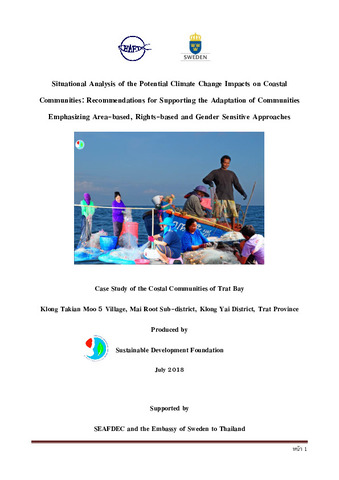
Situational analysis of the potential climate change impacts on coastal communities: Recommendations for supporting the adaptation of communities emphasizing area-based, rights-based and gender sensitive approaches case study of the coastal communities of Trat bay
(Secretariat, Southeast Asian Fisheries Development Center, 2018-07)This case study has objectives of assessing vulnerability of coastal communities from climate change, and to proposing guidelines for integrating capacity building on holistic adaptation of communities to climate change ... -
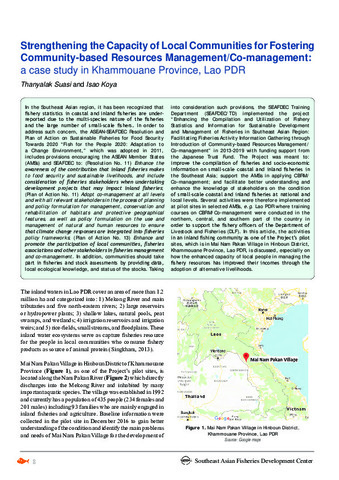
Strengthening the capacity of local communities for fostering community-based resources management/co-management: a case study in Khammouane Province, Lao PDR
(Secretariat, Southeast Asian Fisheries Development Center, 2019)In the Southeast Asian region, it has been recognized that fishery statistics in coastal and inland fisheries are underreported due to the multi-species nature of the fisheries and the large number of small-scale fishers. ... -
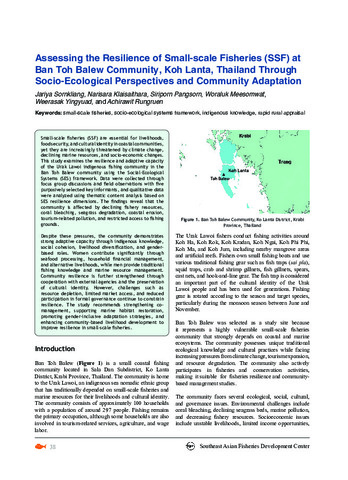
Assessing the Resilience of Small-scale Fisheries (SSF) at Ban Toh Balew Community, Koh Lanta, Thailand Through Socio-Ecological Perspectives and Community Adaptation
(Secretariat, Southeast Asian Fisheries Development Center, 2026-10)Small-scale fisheries (SSF) are essential for livelihoods, food security, and cultural identity in coastal communities, yet they are increasingly threatened by climate change, declining marine resources, and socio-economic ...