
Establishing spatio-temporal profile of scombrid larvae: the Philippine Eastern Pacific seaboard in focus
Share
ບົດຄັດຫຍໍ້
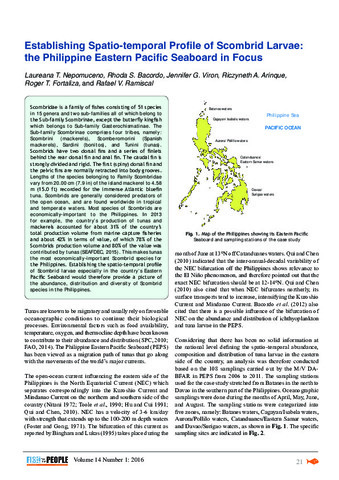
Scombridae is a family of fishes consisting of 51 species in 15 genera and two sub-families all of which belong to the Sub-family Scombrinae, except the butterfly kingfish which belongs to Sub-family Gasterochismatinae. The Sub-family Scombrinae comprises four tribes, namely: Scombrini (mackerels), Scomberomorini (Spanish mackerels), Sardini (bonitos), and Tunini (tunas). Scombrids have two dorsal fins and a series of finlets behind the rear dorsal fin and anal fin. The caudal fin is strongly divided and rigid. The first (spiny) dorsal fin and the pelvic fins are normally retracted into body grooves. Lengths of the species belonging to Family Scombridae vary from 20.00 cm (7.9 in) of the island mackerel to 4.58 m (15.0 ft) recorded for the immense Atlantic bluefin tuna. Scombrids are generally considered predators of the open ocean, and are found worldwide in tropical and temperate waters. Most species of Scombrids are economically-important to the Philippines. In 2013 for example, the country's production of tunas and mackerels accounted for about 31% of the country's total production volume from marine capture fisheries and about 42% in terms of value, of which 78% of the Scombrids production volume and 80% of the value was contributed by tunas (SEAFDEC, 2015). This makes tunas the most economically-important Scombrid species for the Philippines. Establishing the spatio-temporal profile of Scombrid larvae especially in the country's Eastern Pacific Seaboard would therefore provide a picture of the abundance, distribution and diversity of Scombrid species in the Philippines.
Suggested Citation
Nepomuceno, L. T., Bacordo, R. S., Viron, J. G., Arinque, R. A., Fortaliza, R. T., & Ramiscal, R. V. (2016). Establishing spatio-temporal profile of scombrid larvae: the Philippine Eastern Pacific seaboard in focus. Fish for the People , 14(1), 21-29. http://hdl.handle.net/20.500.12066/982
