SEAFDEC Institutional Repository: Recent submissions
Now showing items 561-580 of 5923
-
Application of carriers and RNAi to enhance the antiviral immune response of shrimp to WSSV
(Aquaculture Department, Southeast Asian Fisheries Development Center, 2021-12)In aquaculture, vaccination is one of the approaches for disease prevention and control. The aim of the present study was to determine the efficacy of a VP28 double stranded RNA (VP28 dsRNA) and recombinant VP28 protein ... -
Efficacy of the inactivated nervous necrosis virus vaccine against viral nervous necrosis in pond-reared orange-spotted grouper Epinephelus coioides
(Aquaculture Department, Southeast Asian Fisheries Development Center, 2021-12)The field efficacy of the formalin-inactivated nervous necrosis virus (NNV) against viral nervous necrosis (VNN) in orange-spotted grouper (Epinephelus coioides) reared in floating net cages in earthen pond was investigated. ... -
Establishment of threshold infection levels of WSSV in different weight ranges of Penaeus vannamei using quantitative PCR (qPCR)
(Aquaculture Department, Southeast Asian Fisheries Development Center, 2021-12)Threshold infection level is the pathogen load of the test animals measured before the appearance of clinical signs and mortality. This study aims to establish the threshold infection levels of WSSV in different weight ... -
Research update on emergent shrimp pathogens in Thailand
(Aquaculture Department, Southeast Asian Fisheries Development Center, 2021-12)Recent evidence suggest that the emergent microsporidian, Enterocytozoon hepatopenaei (EHP) is a component cause of white feces syndrome (WFS) in shrimp. The natural WFS shrimp were found to be infected with EHP. At the ... -
Acute hepatopancreatic necrosis disease (AHPND)) and hepatopancreatic microsporidiosis (HPM):): Two threats to sustainable shrimp aquaculture
(Aquaculture Department, Southeast Asian Fisheries Development Center, 2021-12)Infectious diseases caused by viruses and bacteria are a major threat to sustainable shrimp farming globally. Since early 80’s viral diseases such as White Spot Disease, Taura Syndrome disease have caused enormous losses ... -
Department of Animal Health (DAH) report of emergency diseases - prevention and control of shrimp diseases in from 2016 to 2018
(Aquaculture Department, Southeast Asian Fisheries Development Center, 2021-12)Acute Hepatopancreatic Necrosis Disease (AHPND), known as Early Mortality Syndrome (EMS) before 2013, was first reported in Vietnam from the Mekong River Delta without laboratory confirmation in the end of 2010. Vibrio ... -
Report of aquatic animal diseases in Thailand during January – June 2019
(Aquaculture Department, Southeast Asian Fisheries Development Center, 2021-12)Aquaculture is an important industry in Thailand which has been established more than two decades ago. The cultured species are divided into two main groups; shrimp and finfish farming. The major cultured shrimp species ... -
Country report - Singapore
(Aquaculture Department, Southeast Asian Fisheries Development Center, 2021-12)The aquaculture industry produces about 10 % of Singapore’s annual local fish consumption. By 2030, the country’s goal is for the agri-food industry to produce 30 % of Singapore’s nutritional needs. In order to achieve ... -
Status of aquatic animal health in the Philippines
(Aquaculture Department, Southeast Asian Fisheries Development Center, 2021-12)The national aquatic animal disease surveillance and reporting system is implemented by the Bureau of Fisheries and Aquatic Resources in coordination with other recognized laboratories. It covers the OIE/NACA listed diseases ... -
Aquatic animal health in Myanmar
(Aquaculture Department, Southeast Asian Fisheries Development Center, 2021-12)In 2010, several viruses infected Penaeus monodon in the ponds of Myanmar. This includes the White Spot Syndrome Virus (WSSV) which causes the White Spot Disease (WSD). In addition, Taura Syndrome Virus (TSV) and Infectious ... -
Country report aquatic animal health in Malaysia
(Aquaculture Department, Southeast Asian Fisheries Development Center, 2021-12)The fisheries sector of Malaysia plays a significant role in economic development. It provides employment, foreign exchange and protein supply for the country. In 2017, aquaculture production in Malaysia was 427,022 tonnes, ... -
Report on aquatic animal health in Lao PDR
(Aquaculture Department, Southeast Asian Fisheries Development Center, 2021-12)Fish production is very important to Lao PDR. It is an important source of protein to its citizens. Lao PDR is fortunate to have numerous water resources. The Mekong River flows through Lao PDR for a length of 1,865 km. ... -
Status of aquatic animal health in Indonesia
(Aquaculture Department, Southeast Asian Fisheries Development Center, 2021-12)Fish disease is one of the main obstacles in the success of aquaculture production because of the loss caused by it. The outbreak of diseases has resulted to a substantial economic loss which was reported to have reached ... -
The status of aquatic animal health in Cambodia
(Aquaculture Department, Southeast Asian Fisheries Development Center, 2021-12)Human population in Cambodia keeps increasing from year to year and the demand for food consumption also increases. Food products in Cambodia come from two main sources: terrestrial and aquatic. In this sense, aquaculture ... -
Training updates on marine fish hatchery
(Aquaculture Department, Southeast Asian Fisheries Development Center, 2021-12)One of the major constraints confronting the sustainable development of the aquaculture industry in the world, particularly in Southeast Asia, is the availability of quality fish seeds for stocking in ponds and cages. With ... -
Promotion of resource enhancement of seahorse in an island community in Negros Occidental, Central Philippines
(Aquaculture Department, Southeast Asian Fisheries Development Center, 2021-12)To promote the protection and sustainability of seahorses for their conservation, efforts have been done through stock enhancement by releasing captive-bred seahorses. However, preparatory activities are necessary for the ... -
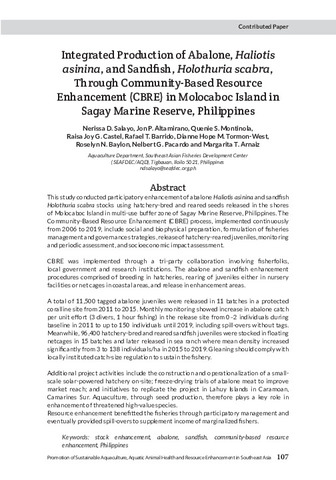
Integrated production of abalone, Haliotis asinina, and sandfish, Holothuria scabra, through Community-Based Resource Enhancement (CBRE) in Molocaboc Island in Sagay Marine Reserve, Philippines
(Aquaculture Department, Southeast Asian Fisheries Development Center, 2021-12)This study conducted participatory enhancement of abalone Haliotis asinina and sandfish Holothuria scabra stocks using hatchery-bred and reared seeds released in the shores of Molocaboc Island in multi-use buffer zone of ... -
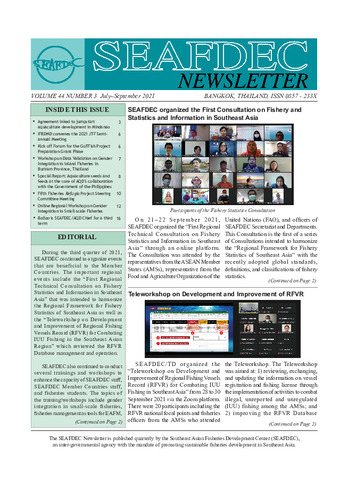
SEAFDEC Newsletter Vol. 44 No. 3
(Secretariat, Southeast Asian Fisheries Development Center, 2021-12-15)During the third quarter of 2021, SEAFDEC continued to organize events that are beneficial to the Member Countries. The important regional events include the “First Regional Technical Consultation on Fishery Statistics and ... -
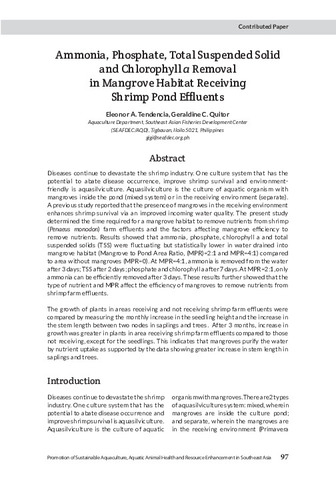
Ammonia, phosphate, total suspended solid and chlorophyll a removal in mangrove habitat receiving shrimp pond effluents
(Aquaculture Department, Southeast Asian Fisheries Development Center, 2021-12)Diseases continue to devastate the shrimp industry. One culture system that has the potential to abate disease occurrence, improve shrimp survival and environmentfriendly is aquasilviculture. Aquasilviculture is the culture ... -
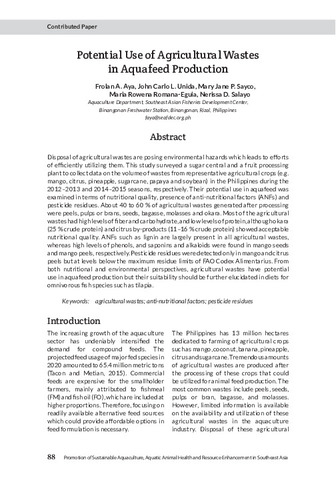
Potential use of agricultural wastes in aquafeed production
(Aquaculture Department, Southeast Asian Fisheries Development Center, 2021-12)Disposal of agricultural wastes are posing environmental hazards which leads to efforts of efficiently utilizing them. This study surveyed a sugar central and a fruit processing plant to collect data on the volume of wastes ...