Sustainable management of inland capture fisheries for food security: Experience of Indonesia
Share
abstrak
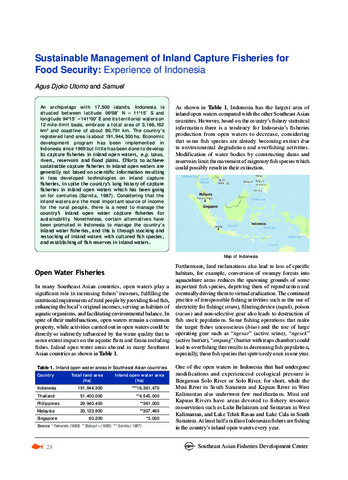
An archipelago with 17,500 islands, Indonesia is situated between latitude 06° 08’ N – 11° 15’ S and longitude 94° 15’ – 141° 00’ E and its territorial waters on 12 mile-limit basis, embrace a total area of 3,166,162 km 2 and coastline of about 80,791 km. The country’s registered land area is about 191,944,300 ha. Economic development program has been implemented in Indonesia since 1969 but little has been done to develop its capture fisheries in inland open waters, e.g. lakes, rivers, reservoirs and flood plains. Efforts to achieve sustainable capture fisheries in inland open waters are generally not based on scientific information resulting in less developed technologies on inland capture fisheries, in spite the country’s long history of capture fisheries in inland open waters which has been going on for centuries (Sarnita, 1987). Considering that the inland waters are the most important source of income for the rural people, there is a need to manage the country’s inland open water capture fisheries for sustainability. Nonetheless, certain alternatives have been promoted in Indonesia to manage the country’s inland water fisheries, and this is through stocking and restocking of inland waters with cultured fish species, and establishing of fish reserves in inland waters.
Suggested Citation
Utomo, A. D., & Samuel (2017). Sustainable management of inland capture fisheries for food security: Experience of Indonesia. Fish for the People , 15(2), 28-35. http://hdl.handle.net/20.500.12066/1195
Subjek

Koleksi
Related items
Showing items related by title, author, creator and subject.
-
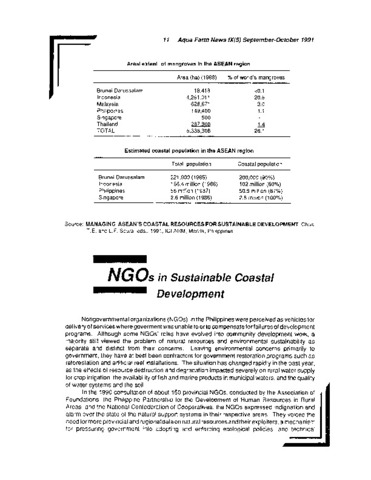
NGOs in sustainable coastal development
(Aquaculture Department, Southeast Asian Fisheries Development Center, 1991) -
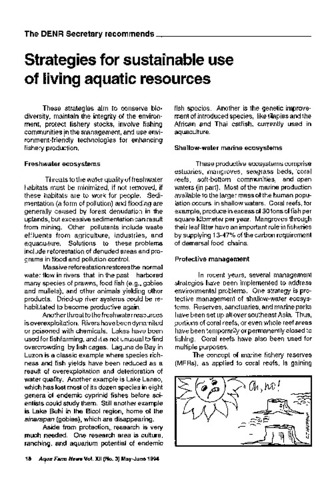
Strategies for sustainable use of living aquatic resources
(Aquaculture Department, Southeast Asian Fisheries Development Center, 1994) -
Institutional capacity development for sustainable aquaculture and fisheries: Strategic partnership with local institutions
(Terrapub, 2008)Many people living in the rural areas in the Philippines, as in other developing countries in Southeast Asia, depend on aquatic resources for their food and livelihood. For the past two decades, the Aquaculture Department ...