Tilapia cage culture and the dissolved oxygen trends in Sampaloc Lake, the Philippines
Share
Abstract
The 28-hectare tilapia cage culture that occupied the 104-hectare Sampaloc Lake, a crater lake, shifted to intensive method in 1986 when tilapia growth slowed done at the beginning of 1982. Thus, commercial feeds became the main source of allochthonous organic matter in the lake. Total feeds given annually for the 28-hectare cage culture at 3 croppings per year amounted to 5250 tons. At feed conversion ratio of 1 : 2 a significant portion of the feeds given ended as organic wastes in the lake. In 1988, tilapia cage operators began experiencing their worst occurrences of fishkill, worth millions of pesos. An assessment of the dissolved oxygen condition of Sampaloc lake in late 1989, 1990 and mid-1991 showed ominous trends which might adversely affect the use of Sampaloc lake for fishery.
Suggested Citation
Santiago, A. E., & Arcilla, R. P. (1993). Tilapia cage culture and the dissolved oxygen trends in Sampaloc Lake, the Philippines. Environmental Monitoring and Assessment , 24(3), 243-255. https://doi.org/10.1007/BF00545981
Subject
Koleksi
- AQD Journal Articles [1249]
Related items
Showing items related by title, author, creator and subject.
-
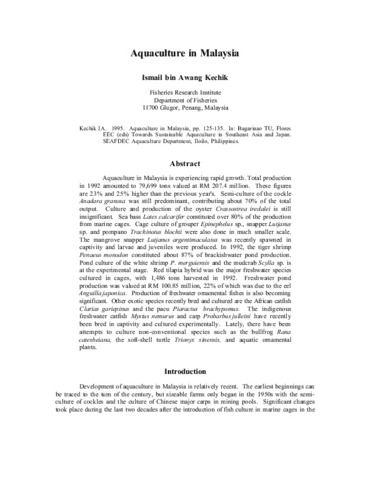
Aquaculture in Malaysia
(Aquaculture Department, Southeast Asian Fisheries Development Center, 1995)Aquaculture in Malaysia is experiencing rapid growth. Total production in 1992 amounted to 79,699 tons valued at RM 207.4 million. These figures are 23% and 25% higher than the previous year's. Semi-culture of the cockle ... -
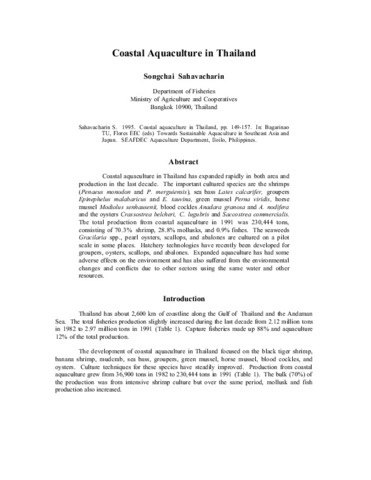
Coastal aquaculture in Thailand
(Aquaculture Department, Southeast Asian Fisheries Development Center, 1995)Coastal aquaculture in Thailand has expanded rapidly in both area and production in the last decade. The important cultured species are the shrimps (Penaeus monodon and P. merguiensis), sea bass Lates calcarifer, groupers ... -
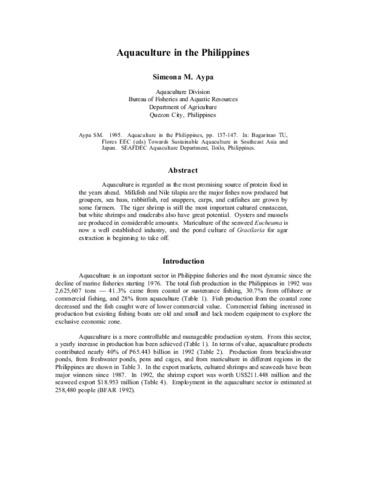
Aquaculture in the Philippines
(Aquaculture Department, Southeast Asian Fisheries Development Center, 1995)Aquaculture is regarded as the most promising source of protein food in the years ahead. Milkfish and Nile tilapia are the major fishes now produced but groupers, sea bass, rabbitfish, red snappers, carps, and catfishes ...