Managing fisheries conflicts through communication planning: Experience from inland fisheries of Bangladesh
Quan điểm/
Ngày
2009Page views
866metadata
Hiển thị bản ghi đầy đủ mặt hàngCited times in Scopus
Share
trừu tượng
Increasing population, ineffective management, competition among fishing gears over access to resources and proliferation of destructive practices are imposing severe stress on the inland water bodies of Bangladesh. These factors also contribute to the increasing incidence of conflicts among fishery stakeholders. When unabated, these conflicts are potential threats to the livelihoods of millions of the poorest fishing communities that depend on these resources. Effective communication between conflicting parties is perceived as a key for establishing successful negotiations for managing conflicts. On this premise, this paper presents and assesses a Fisheries Conflicts Communication Framework, henceforth called FishCom, a tool for developing plans and strategies for managing fisheries conflicts in the inland fisheries of Bangladesh. This tool embodies a structured participatory process intended for use by policy-makers and conflict management practitioners. They have important roles in catalyzing and effecting changes that are instrumental in minimizing, if not totally eliminating conflicts. Experiences from applying FishCom in the inland fisheries study sites in Bangladesh show that it has enabled a systematic stakeholder-inclusive identification and evaluation of fisheries conflicts and planning of communication interventions to manage them.
Suggested Citation
Murshed-e-Jahan, K., Salayo, N. D., & Kanagaratnam, U. (2009). Managing fisheries conflicts through communication planning: Experience from inland fisheries of Bangladesh. Fisheries Research , 99(2), 112-122. https://doi.org/10.1016/j.fishres.2009.04.009
Chủ thể

Bộ sưu tập
- AQD Journal Articles [1249]
Related items
Showing items related by title, author, creator and subject.
-
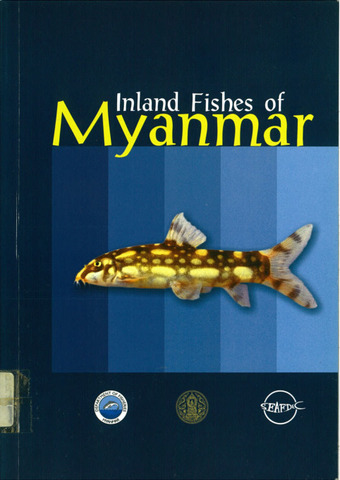
Inland fishes of Myanmar
(Secretariat, Southeast Asian Fisheries Development Center, 2005-12)This handbook of some inland fishes in Myanmar was based on a rapid field survey of SEAFDEC supported team and long term observation of the authors on common species and some taxa, obtained from the aquarium trade. We ... -
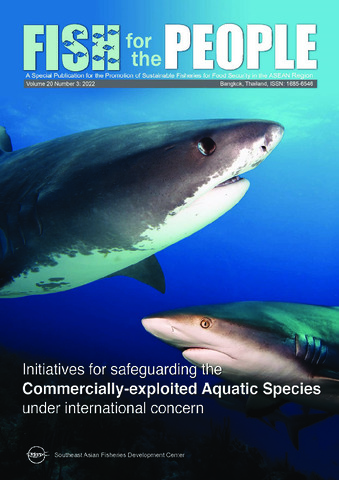
Fish for the People Vol.20 No.3
(Secretariat, Southeast Asian Fisheries Development Center, 2023-02)Aquatic species are exploited for food security and livelihood but some of them could be fully exploited or overexploited if not properly managed. The ASEAN Member States (AMSs), i.e. Indonesia, Philippines, Thailand, and ... -
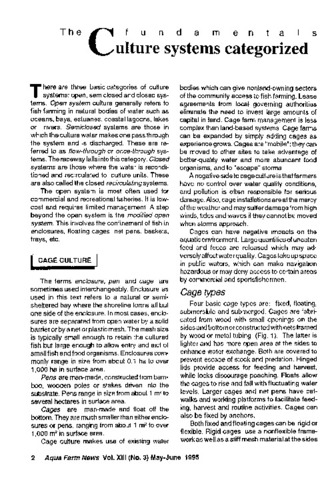
Culture systems categorized: The fundamentals
(Aquaculture Department, Southeast Asian Fisheries Development Center, 1995)The article presents the three basic categories of culture systems: open, semiclosed and closed systems. Open system culture generally refers to fish farming in natural bodies of water such as oceans, bays, estuaries, ...