
Freezing effects of raw materials on threadfin bream surimi gel quality
Share
abstrak
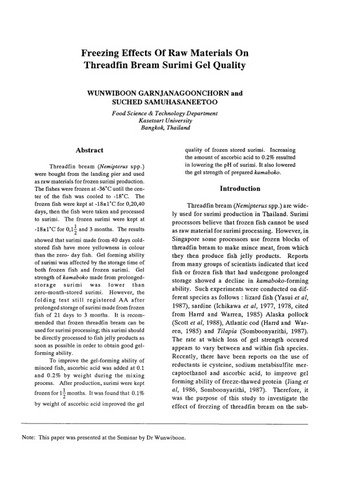
Threadfin bream (Nemipterus spp.) were bought from the landing pier and used as raw materials for frozen surimi production. The fishes were frozen at -36°C until the center of the fish was cooled to -18"C. The frozen fish were kept at -18±1°C for 0,20,40 days, then the fish were taken and processed to surimi. The frozen surimi were kept at -18±1°C for 0,1½ and 3 months. The results showed that surimi made from 40 days cold-stored fish have more yellowness in colour than the zero- day fish. Gel forming ability of surimi was affected by the storage time of both frozen fish and frozen surimi. Gel strength of kamaboko made from prolonged-storage surimi was lower than zero-month-stored surimi. However, the folding test still registered AA after prolonged storage of surimi made from frozen fish of 21 days to 3 months. It is recommended that frozen threadfin bream can be used for surimi processing; this surimi should be directly processed to fish jelly products as soon as possible in order to obtain good gel-forming ability.
To improve the gel-forming ability of minced fish, ascorbic acid was added at 0.1 and 0.2% by weight during the mixing process. After production, surimi were kept frozen for 1½ months. It was found that 0.1% by weight of ascorbic acid improved the gel quality of frozen stored surimi. Increasing the amount of ascorbic acid to 0.2% resulted in lowering the pH of surimi. It also lowered the gel strength of prepared kamaboko.
Suggested Citation
Garnjanagoonchorn, W., & Samuhasaneetoo, S. (1991). Freezing effects of raw materials on threadfin bream surimi gel quality. In K. K. Hooi, K. Miwa, & M. B. Salim (Eds.), Proceedings of the Seminar on Advances in Fishery Post-Harvest Technology in Southeast Asia: Singapore, 6-11 May, 1991 (pp. 170-175). Singapore: Marine Fisheries Research Department, Southeast Asian Fisheries Development Center.